

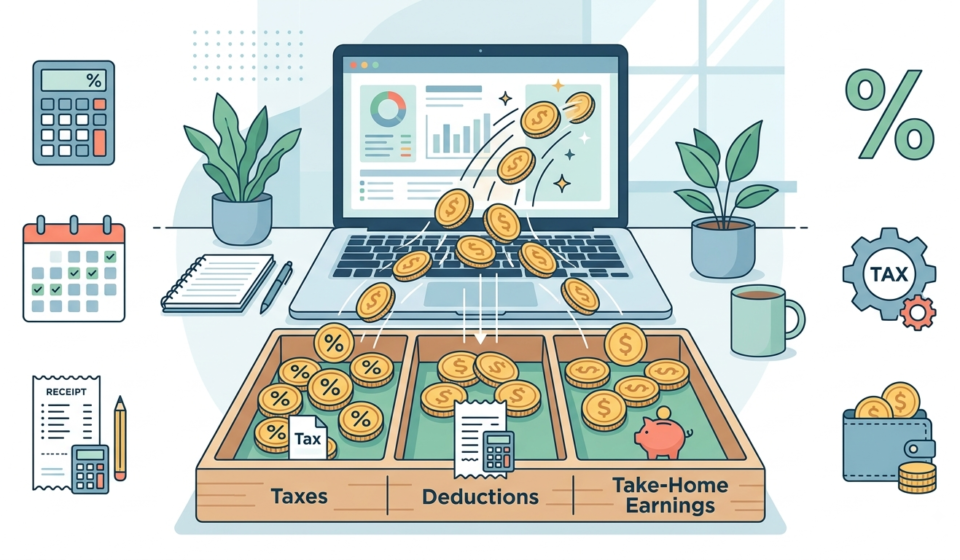

Starting a side hustle is exciting — until tax season arrives and you realize the income you earned comes with a tax bill you did not plan for.
This is one of the most common surprises for new side hustlers, freelancers, and anyone earning money outside a traditional job. When you work for an employer, taxes are withheld from each paycheck automatically. When you earn side income, nothing is withheld — you are responsible for calculating, setting aside, and paying the tax yourself.
This guide provides a clear self-employment tax guide for beginners. It covers how to file taxes for side income, what self-employment tax actually is, what you can deduct, and how to avoid a surprise bill. If you have already started earning, the principles here apply to most side hustle taxes situations.
If you have not started yet, read our guide on how to start a side hustle first, then come back here so you are set up correctly from day one.
Why Side Income Changes Your Taxes
When you earn money as an employee, your employer withholds income tax and payroll tax from each paycheck and sends them to the tax authorities on your behalf. You see a smaller paycheck, but your tax obligation is being handled throughout the year.
Side hustle income works differently. When a client pays you, you receive the full amount — but no taxes have been withheld. At tax time, you owe income tax on that money, and in most cases you also owe self-employment tax on it.
This is why so many new side hustlers get caught off guard: they spend the full amount they received, then discover months later that a portion of it was never really theirs to keep.
The good news is that once you understand how the system works, managing it becomes a simple habit — set aside a percentage, track your expenses, and file correctly.
What Is Self-Employment Tax?
Self-employment tax is the tax that covers social safety programs — the equivalent of the payroll taxes that an employer would normally withhold and match.
When you are an employee, you pay roughly half of these payroll taxes and your employer pays the other half. When you are self-employed — including side hustle income — you are both the employer and the employee, so you pay both halves.
This means the tax rate on self-employment income is higher than what you see withheld from a regular paycheck, because you are covering the portion an employer would normally pay.
Income Tax Still Applies Too
Self-employment tax is separate from income tax. On your side income, you may owe both:
- Self-employment tax: a flat percentage on your net earnings
- Income tax: based on your total income and tax bracket, which varies by your location and filing situation
The exact rates depend on where you live and how much you earn. The key takeaway is that side income is usually taxed twice — once for self-employment tax and once for income tax — and you need to plan for both.
How Much Should You Set Aside for Taxes?
A common rule of thumb is to set aside 25% to 30% of your side income for taxes. This covers self-employment tax and a portion of income tax for most people.
The exact percentage depends on your total income, your tax bracket, and your location. If your side hustle pushes your total income into a higher bracket, you may need to set aside more. If your total income is lower, you may need less.
The safest approach is to set aside 30% from every payment the moment it arrives. If you end up owing less, you keep the surplus. If you set aside too little, you face a bill you may struggle to pay.
This is where a budget becomes essential — your side income needs a plan before it is spent. See our guide on how to budget money to build a system that accounts for taxes first.
What You Can Deduct
Deductions reduce the income you are taxed on, which lowers your tax bill. The general rule is that you can deduct expenses that are ordinary and necessary for your side hustle — costs that are directly related to earning your side income.
Common deductible expenses include:
- Software and tools: subscriptions, apps, and platforms you use for your hustle
- Equipment: a laptop, camera, or other tools used for work
- Home office: a dedicated workspace used regularly and exclusively for your hustle
- Internet and phone: a portion of your bills, based on business use
- Advertising and marketing: ads, website hosting, business cards
- Professional development: courses, books, and training related to your hustle
- Travel: business-related travel, including mileage for driving to clients
- Supplies: materials used to create products or deliver services
- Payment processing fees: fees charged by platforms to receive payments
Keep Records From the Start
Every deductible expense should have a receipt or record. The simplest method is to use a separate account for hustle income and expenses, so every transaction is in one place. Many side hustlers use a basic spreadsheet or accounting app to track deductions throughout the year.
Do Not Mix Personal and Business Expenses
If an expense is partly personal and partly business — like a phone bill — you can only deduct the business portion. Keep clear records of how you calculated the split.
Side Hustle Taxes vs Employee Taxes: Key Differences
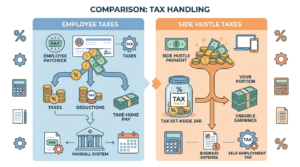
| Feature | Employee Taxes | Side Hustle Taxes |
|---|---|---|
| Tax withholding | Automatic from each paycheck | None — you handle it yourself |
| Self-employment tax | Employer pays half, you pay half | You pay both halves |
| Income tax | Withheld throughout the year | You calculate and pay it |
| Deductions | Limited | Broader — business expenses are deductible |
| Filing | Usually simple, one form | Often requires additional forms |
| Quarterly payments | Not required | May be required if income is significant |
| Record keeping | Minimal | Essential — track income and expenses |
The comparison shows why side hustle taxes feel more complex: you are doing the work an employer’s payroll department would normally handle for you. But once you build the habit, it becomes routine.
Do You Need to Make Quarterly Tax Payments?
If you earn enough side income, you may need to pay taxes throughout the year in quarterly estimated payments rather than waiting until the annual filing deadline.
The rules vary by location, but the general principle is this: if you expect to owe tax above a certain threshold when you file, you may be required to pay estimated taxes in four installments during the year.
If you are unsure whether you need to make quarterly payments, consider these questions:
- Will your side income create a tax bill you cannot cover at filing time?
- Did you owe tax last year that was not covered by withholding?
- Is your side income growing steadily throughout the year?
If the answer to any of these is yes, look into quarterly estimated payments in your area. Paying throughout the year prevents a large lump-sum bill and may help you avoid penalties for underpayment.
How to File Taxes for Side Income
Filing taxes for side income involves a few extra steps compared to a simple employee return. The exact process depends on your location, but the general flow is:
- Gather your income records. Total everything you earned from your side hustle during the year. If you used a separate account, this is easy. If clients sent you tax forms, collect those as well.
- Gather your expense records. Total your deductible expenses for the year. Your spreadsheet or accounting app should have this ready.
- Calculate your net income. Subtract your expenses from your income. This is the amount you are taxed on — not your gross income.
- Fill out the self-employment tax form. Most tax systems require an additional form for self-employment income. This form calculates your self-employment tax based on your net earnings.
- Add it to your regular return. Your side income and self-employment tax are reported alongside your regular income on your annual tax return.
- Review deductions carefully. Make sure you have claimed every legitimate business expense. Missed deductions mean a higher tax bill than necessary.
If your situation is simple, tax software can handle the filing. If your income is significant or your deductions are complex, a tax professional can help you file correctly and find deductions you might miss on your own.
Real-World Example: A Freelancer’s First Tax Year
Consider a graphic designer who earns $8,000 in side income during the year and has $1,200 in deductible expenses.
Gross income: $8,000
Deductible expenses: -$1,200
Net income: $6,800
This $6,800 — not $8,000 — is the amount subject to self-employment tax and income tax.
If they set aside 30% of gross income throughout the year:
$8,000 × 30% = $2,400 saved for taxes
If their actual tax bill on $6,800 of net income is roughly $1,700:
They have $700 left over from what they saved — a comfortable buffer rather than a shortfall.
Compare that to not setting anything aside:
If they spent the full $8,000 during the year:
They would owe roughly $1,700 at tax time with nothing saved — a painful surprise that could force them into debt or a payment plan.
The difference between these two outcomes is not income. It is preparation. Setting aside a percentage from every payment turns a potential crisis into a non-event.
Common Side Hustle Tax Mistakes to Avoid
- Not setting aside money for taxes: The most common and most costly mistake. Set aside 25–30% from every payment.
- Spending gross income as if it is take-home pay: Gross income is not yours to keep — a portion belongs to taxes.
- Failing to track expenses: Missed deductions mean a higher tax bill. Track expenses from day one.
- Mixing personal and business money: Separate accounts make tracking and filing dramatically easier.
- Forgetting about quarterly payments: If your side income is significant, you may owe estimated payments throughout the year.
- Overclaiming deductions: Only deduct legitimate business expenses. Overclaiming can trigger an audit or penalties.
- Waiting until tax season to organize: Scrambling in April is stressful and error-prone. Track monthly instead.
- Assuming side income is too small to tax: Even modest side income may be taxable. Check the rules for your area.
- Not getting help when needed: If your income grows or your situation becomes complex, a tax professional can save you more than they cost.
- Ignoring state or local taxes: Some regions have additional tax obligations for self-employment income beyond national taxes.
Frequently Asked Questions
Do I have to pay taxes on side hustle income?
In most cases, yes. Side hustle income is usually considered self-employment income, which means you may owe both self-employment tax and income tax on it. The exact rules depend on your location and total income.
What is self-employment tax?
Self-employment tax is the tax that covers social safety programs. When you are self-employed, you pay both the employee and employer portions, which is why the rate is higher than what is withheld from a regular paycheck.
How much should I set aside for side hustle taxes?
A common rule of thumb is 25% to 30% of your side income. This covers self-employment tax and a portion of income tax for most people. If your side income pushes you into a higher tax bracket, you may need to set aside more.
What can I deduct on my side hustle taxes?
You can generally deduct expenses that are ordinary and necessary for your hustle — software, equipment, a home office, internet and phone costs, advertising, professional development, travel, and supplies. Keep receipts and records for every deduction.
Do I need to make quarterly tax payments?
If you expect to owe tax above a certain threshold when you file, you may be required to make quarterly estimated payments. The rules vary by location, so check what applies to your situation if your side income is significant.
How do I file taxes for side income?
Gather your income and expense records, calculate your net income, fill out the self-employment tax form required in your area, and add it to your annual tax return. Tax software can handle simple situations; a professional can help with complex ones.
Is side hustle income taxed differently from employee income?
Yes. Employees have taxes withheld automatically and their employer pays half of payroll taxes. Side hustlers receive full payments with nothing withheld and pay both halves of self-employment tax, plus they can deduct business expenses.
What happens if I do not set aside money for taxes?
You may face a tax bill you cannot pay at filing time, which could lead to penalties, interest, or a payment plan. Setting aside a percentage from every payment prevents this entirely.
Key Takeaways
- Side hustle income usually has no tax withheld, so you are responsible for calculating and paying it yourself.
- Self-employment tax covers social safety programs, and you pay both the employee and employer portions.
- Set aside 25% to 30% of every side income payment to cover both self-employment tax and income tax.
- You can deduct ordinary and necessary business expenses, which lowers your taxable income.
- Track income and expenses from day one using a separate account or accounting tool.
- You may need to make quarterly estimated tax payments if your side income is significant.
- Filing involves reporting net income (income minus expenses) on the self-employment tax form alongside your regular return.
- A budget that accounts for taxes first prevents the most common side hustle mistake.
To build the full system around your side income, read our guide on how to start a side hustle for the framework, and our list of 15 best side hustles for beginners for ideas. To make sure your extra income — after taxes — is directed toward your goals, see our guide on how to budget money.
Side income can accelerate your financial progress, but only if you plan for the tax bill before it arrives. Set aside a portion from every payment, track your expenses, and file correctly — and your side hustle becomes a net gain rather than a tax surprise.
This article is for informational purposes only and is not tax, legal, or financial advice. Tax rules vary by location, income level, and filing situation. Consult a licensed tax professional for advice specific to your circumstances.