

For most of modern work history, the default financial plan was simple: get a job, keep the job, rely on the job. One paycheck covered the bills, and loyalty to one employer was seen as both safe and responsible.
That model still works for some, but it carries a risk that more people are recognizing. When 100% of your income comes from one source, losing that source means losing 100% of your income overnight. A layoff, a company closure, an illness, or an industry downturn can turn stability into crisis in a single day.
This guide explains how to diversify your income — why income diversification matters now more than ever, what multiple income streams realistically look like, and how to start building them without abandoning your main job. If you have ever wondered why you need multiple income sources, the answer comes down to one word: resilience.
If you are already building a side hustle, this is the broader strategy that ties it together. And if you are starting from a single paycheck, this is the framework for turning one stream into several over time.
Why One Paycheck Is Not Enough
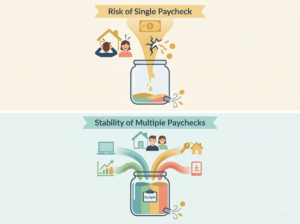
The case for diversification starts with a simple reality: income sources can fail, and they often fail without much warning.
Job Loss Can Happen to Anyone
Layoffs are rarely personal. Companies restructure, industries shrink, and economic downturns push otherwise stable employers to cut staff. Even strong performers lose jobs when the broader conditions change.
Illness and Emergencies Disrupt Income
An injury or illness that prevents you from working can stop your income just as completely as a layoff — and with less warning. If your only income depends on your ability to show up and work, your financial plan has a hidden single point of failure.
Industries Change
Entire industries can decline as technology, consumer behavior, or regulation shifts. A job that felt secure for a decade can become vulnerable in a year. Diversifying across different types of income reduces your exposure to any one industry’s risks.
Inflation Erobs a Single Income
A single paycheck that does not grow fast enough loses purchasing power over time. Additional income streams can help you keep pace with rising costs without depending entirely on raises from one employer.
The Cost of No Backup Plan
When a single income stops, the fallback is usually debt or savings depletion. Without a second stream, a job loss can quickly force you into high-interest borrowing just to cover basics — the opposite of financial security. Read our guide on how to get out of debt to understand how hard that cycle is to reverse once it starts.
What Income Diversification Actually Means
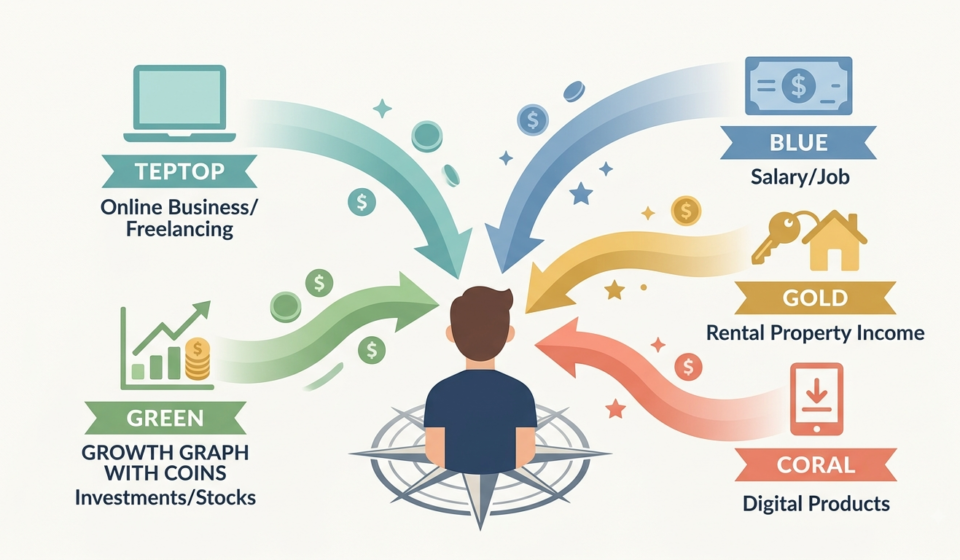
Income diversification is not about having five jobs. It is about building income from sources that do not all depend on the same thing.
A diversified income plan spreads earnings across categories that are independent of each other — so if one slows or stops, the others continue. The goal is not maximum income; it is resilient income.
The Three Main Categories of Income
| Income Type | What It Is | Examples |
|---|---|---|
| Active (earned) income | You trade time for money | Salary, freelance work, side hustles, consulting |
| Passive (portfolio or passive) income | Income from assets you own | Dividends, interest, rental income, royalties |
| Semi-passive income | Heavy upfront work, low ongoing effort | Digital products, content libraries, some businesses |
A healthy diversified plan usually includes at least two of these three categories. Someone with a full-time job and a side hustle has two active streams. Someone with a job, a side hustle, and an investment portfolio has active plus passive — a stronger position.
How Many Income Streams Do You Need?
There is no universal number, but a useful framework is the rule of three: aim for at least three independent income sources before considering your plan resilient.
Stream 1: Your Primary Income
This is your main job or business. For most people, it is the largest stream and the one that covers essential expenses. Protect it — it is your foundation.
Stream 2: A Secondary Active Stream
This is a side hustle, freelance work, or part-time work that you control. It does not need to match your main income, but it should be enough to cover a meaningful portion of expenses if the primary stream stops. Read our guide on how to start a side hustle to build this stream.
Stream 3: A Passive or Semi-Passive Stream
This is income from an asset — investments, a rental property, digital products, or content royalties. It takes time to build but eventually earns with less ongoing effort. See our guide on passive income myths vs reality to understand which options are genuinely passive.
If you have these three, you have a basic safety net: if any one stream stops, the other two can sustain you while you rebuild.
How to Build Multiple Income Streams: A Step-by-Step Path
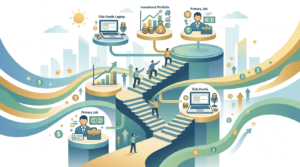
Building multiple streams is not something you do in a week. It is a multi-year process that follows a logical order.
Step 1: Stabilize Your Primary Income
Before adding streams, make sure your main income is solid. If your job is unstable or your business is struggling, fix that first. Diversification is not a substitute for a strong foundation.
Step 2: Build a Cash Buffer
Before investing time or money into new income sources, build a basic emergency fund. New income streams take time to generate cash, and you need a buffer to survive the gap. Read our emergency fund guide to size this correctly.
Step 3: Add a Side Hustle
Once your foundation is solid, add a side hustle that uses skills you already have. This is your first new stream — active income you control. Start small, prove it works, then grow it to a meaningful monthly amount. See our list of 15 best side hustles for beginners for ideas.
Step 4: Convert Extra Income Into Assets
Once your side hustle generates more than you need for expenses, direct the surplus into assets that generate passive income. This is the shift from active to passive — from trading time for money to owning things that earn for you. Read our guide on passive income myths vs reality to understand this transition.
Step 5: Continue Adding Streams Over Time
As your assets grow, add another stream when the opportunity is right. This could be another side hustle, a rental property, or a digital product. The goal is gradual growth, not rapid expansion that overwhelms you.
Common Barriers to Diversifying Income (and How to Overcome Them)
“I do not have time”
Most people do have time — they have not prioritized it. Start with three to five hours per week. A side hustle that earns even $200 per month is a second income stream, and it does not require giving up your evenings entirely.
“I do not have money to invest”
You do not need money to start a service-based side hustle. Use skills you already have to earn first, then invest the earnings into passive assets later. Diversification is not only for people with capital.
“My job already takes all my energy”
If your job is genuinely draining you, the issue may be the job, not diversification. Building a second stream can also give you an exit option — and sometimes the motivation to improve your primary situation.
“I do not know what I would do”
Most people underestimate the skills they already have. Start with what you know. See our 15 best side hustles for beginners for ideas that use common skills and require little startup money.
“It feels overwhelming”
Start with one stream at a time. Do not try to build a side hustle and an investment portfolio and a rental property simultaneously. Sequential growth is sustainable; simultaneous growth is chaos.
Real-World Example: From One Paycheck to Three Streams
Consider a full-time employee earning a steady salary who decides to diversify over three years.
Year 1 — Foundation and side hustle:
- Primary income: full-time salary
- Builds emergency fund to three months of expenses
- Starts a freelance writing side hustle using existing skills
- Side hustle income by end of year 1: $300 per month
- Income streams: 2
Year 2 — Growing the side hustle and starting to invest:
- Side hustle grows to $500 per month with two regular clients
- Directs $200 per month into a diversified investment portfolio
- Portfolio generates small dividends by end of year: roughly $15 per quarter
- Income streams: 3 (active job, active side hustle, passive dividends)
Year 3 — Stabilizing the three streams:
- Side hustle stable at $500 per month
- Portfolio has grown to roughly $6,000, generating roughly $60 per quarter in dividends
- Total non-salary income: roughly $2,640 per year
- Income streams: 3, with growing passive component
After three years, this person has not replaced their salary — but they have roughly $2,640 per year coming in from sources other than their employer. If the job disappeared tomorrow, they have income to help bridge the gap, plus skills and assets that continue producing.
This is what realistic diversification looks like: gradual, deliberate, and built one stream at a time.
Common Income Diversification Mistakes to Avoid
- Trying to build too many streams at once: Spreading effort across five ideas means none of them grow. Build one at a time.
- Diversifying before stabilizing primary income: A shaky foundation makes everything harder. Fix the main income first.
- Skipping the emergency fund: New streams take time to pay off. You need a cash buffer to survive the gap.
- Confusing more income with more security: More income helps, but only if it is directed intentionally — not absorbed by lifestyle creep.
- Choosing streams that all depend on the same factor: If all your income depends on the same industry or skill, you are not truly diversified.
- Ignoring passive income: Active income alone means you stop earning the moment you stop working. Assets extend income beyond your time.
- Giving up too early: New income streams take months to produce meaningful results. Patience is part of the strategy.
- Underestimating small streams: A $200-per-month side hustle may seem small, but it is a real second stream that can grow.
- Forgetting to protect the primary income: Your main job is still your foundation. Do not neglect it while building side streams.
- Not directing extra income toward goals: Additional income without a purpose gets spent. Direct it toward debt, savings, or investing.
Frequently Asked Questions
Why do I need multiple income sources?
A single income source is a single point of failure. If it stops — through job loss, illness, or industry change — you lose 100% of your income. Multiple streams mean that if one stops, others continue, giving you time and flexibility to recover.
How many income streams should I have?
A useful target is at least three independent sources: a primary income, a secondary active stream like a side hustle, and a passive or semi-passive stream from assets. The exact number depends on your goals and circumstances.
What is income diversification?
Income diversification is spreading your earnings across sources that do not all depend on the same thing — for example, a job, a side hustle, and investments. The goal is resilient income, not maximum income.
Can I diversify my income with no money?
Yes. Service-based side hustles like freelance writing, tutoring, or virtual assistant work require skills and time, not capital. Start with active income and invest the surplus into passive assets later.
How do I start diversifying my income?
Start by stabilizing your primary income and building a cash buffer. Then add one side hustle using skills you already have. Once it generates surplus income, invest that surplus into assets that generate passive income.
Is a side hustle enough to diversify?
A side hustle is a strong start, but true diversification includes income from different categories — active and passive. A side hustle plus an investment portfolio is more resilient than two side hustles that both depend on your time.
How long does it take to build multiple income streams?
Most people build meaningful additional streams over one to three years. The first stream (a side hustle) can start within weeks, while passive streams take longer to produce meaningful income. Patience is essential.
What is the difference between active and passive income?
Active income requires your ongoing time and effort to earn — like a salary or freelance work. Passive income comes from assets you own — like dividends, rental income, or royalties — and requires less ongoing effort. See our passive income myths vs reality guide for a full breakdown.
Key Takeaways
- A single paycheck is a single point of failure — diversifying your income protects you against job loss, illness, and industry change.
- Income diversification means earning from sources that do not all depend on the same factor.
- Aim for at least three independent streams: primary income, a secondary active stream, and a passive or semi-passive stream.
- Build streams sequentially, not simultaneously — one at a time is sustainable.
- Stabilize your primary income and build an emergency fund before adding new streams.
- A side hustle is usually the easiest second stream because it uses skills you already have and requires little startup money.
- Direct surplus income into assets that generate passive returns over time.
- Even small additional streams meaningfully reduce your risk — a $200-per-month side hustle is a real second income source.
- Diversification is a multi-year process, not a quick fix.
To build the streams described in this guide, start with our how to start a side hustle guide for your active second stream, see our 15 best side hustles for beginners for ideas, and read our passive income myths vs reality guide for the passive side. For the cash buffer you need before diversifying, read our emergency fund guide. And if debt is standing between you and extra income to invest, our how to get out of debt guide is where to begin.
Diversifying your income is not about working more — it is about depending on less. Build one stream at a time, protect your foundation, and gradually turn a single paycheck into a resilient web of income that can absorb the setbacks you cannot predict.
This article is for informational purposes only and is not financial, tax, or business advice. Income results vary based on effort, skills, market, and location. Consult a licensed professional for advice specific to your situation.