

Search for “passive income” online and you will find no shortage of promises: earn money while you sleep, quit your job in 30 days, build a six-figure income with zero effort. The headlines are seductive, and that is exactly why so many people end up disappointed.
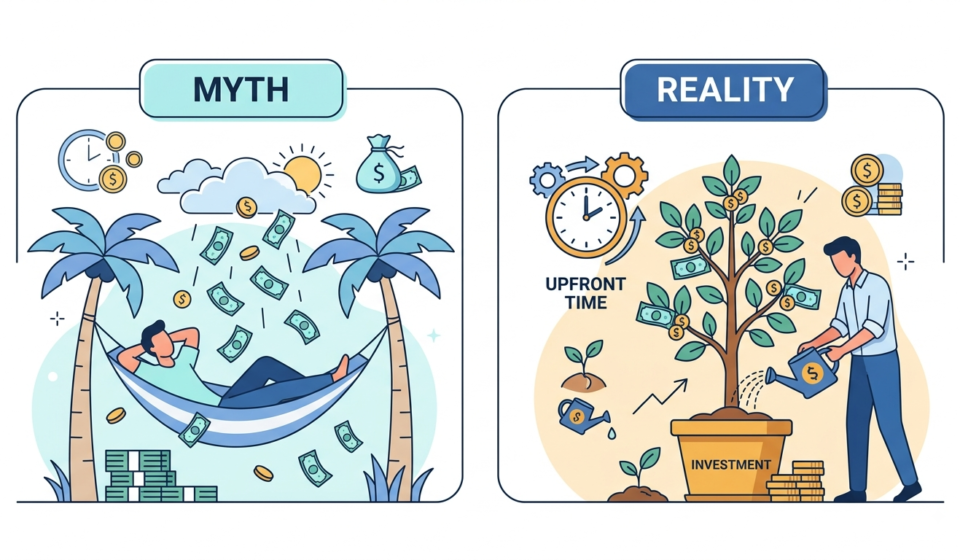
The truth is less glamorous but far more useful. Passive income is real, but it is rarely what the advertisements make it seem. Most of what gets sold as passive income is actually a side hustle with extra steps — and the genuinely passive forms require either significant upfront capital, significant upfront time, or both.
This guide separates passive income myths from reality. It explains what is passive income honestly, compares passive income vs active income, and identifies real passive income ideas that actually work in 2026 — so you can pursue income that genuinely reduces your dependence on trading time for money, rather than chasing shortcuts that do not exist.
If you are still building your first income stream, read our guide on how to start a side hustle first. Passive income is usually a later stage of that journey, not the starting point.
What Is Passive Income, Really?
Passive income is money you earn with minimal ongoing effort after an initial investment of time, money, or both. The keyword is “minimal ongoing effort” — not “zero effort” and not “no investment.”
Every real form of passive income follows the same pattern:
- You invest something up front — money, time, or work
- The investment creates an asset that generates income
- The income continues with less ongoing active work than a job or side hustle
The investment is the part most guides skip. They sell the income without mentioning the cost of building the asset that produces it. That is what creates the myths.
Passive Income vs Active Income: The Key Difference
| Feature | Active Income | Passive Income |
|---|---|---|
| Effort required | Ongoing, per hour or per project | Heavy upfront, light ongoing |
| Income stops when | You stop working | The asset stops producing |
| Examples | Salary, freelance work, hourly side hustles | Dividends, rental income, royalties |
| Time to first dollar | Fast — days or weeks | Slow — months or years |
| Control | You directly control output | You depend on the asset’s performance |
| Risk | Lower (you trade time for money) | Varies — capital and asset risk involved |
The distinction matters because active income is reliable and predictable, while passive income trades certainty for the possibility of earning without your continued time. Most healthy financial plans include both.
The Biggest Passive Income Myths
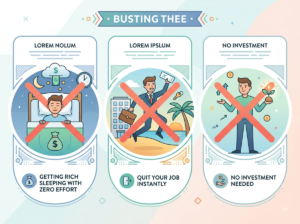
Myth 1: Passive Income Requires No Work
This is the most damaging myth. Every passive income stream requires work to build. A dividend portfolio requires research and capital. A rental property requires purchase, setup, and management. A digital product requires creation and marketing. The income may eventually become passive, but the creation phase is active.
Myth 2: You Can Replace Your Salary Quickly
Most genuine passive income streams take years to match even a modest salary. Building a portfolio that generates meaningful dividends, or a content library that earns consistent royalties, is a multi-year effort. Anyone promising fast replacement income is usually selling a course.
Myth 3: Passive Income Is Free Money
Passive income always costs something — money, time, or both. If you invest capital, you tie up money that could be used elsewhere. If you invest time, you spend months building something that may not pay off. The income is real, but it is never free.
Myth 4: Once Set Up, It Runs Forever
Even genuinely passive income requires monitoring and maintenance. Investments need rebalancing. Rental properties need repairs. Digital products need updates. Content libraries need refreshing as platforms and algorithms change. “Passive” means less ongoing work, not zero ongoing work.
Myth 5: Everyone Can Build Passive Income Easily
Building passive income is possible for most people, but “easily” is misleading. It requires discipline, capital or skills, patience, and the ability to delay gratification — the same qualities that make any financial goal achievable but not automatic.
What Actually Counts as Real Passive Income
Despite the myths, several forms of income are genuinely more passive than a job or side hustle. Here are the most realistic options, along with what they actually require.
Dividend and Investment Income
When you invest in dividend-paying stocks, index funds, or bonds, your investments generate income through dividends and interest. Once the money is invested, the income arrives with no additional work from you.
The catch is that you need capital to start, and meaningful income requires a meaningful portfolio. See our guide on how to start investing with little money to begin building this asset over time.
Upfront cost: Money to invest. Ongoing effort: Low — periodic review and rebalancing. Realistic timeline: Years to build meaningful income.
Rental Income
Owning a property and renting it out generates monthly income. Over time, rental income can become relatively passive, especially if you use a property manager — though management reduces your net income.
The catch is that property requires significant capital, carries maintenance and vacancy risk, and involves more ongoing work than most other passive income forms.
Upfront cost: Significant — down payment, closing costs, repairs. Ongoing effort: Moderate — maintenance, tenant management. Realistic timeline: Months to first income, years to become stable.
Digital Products
An ebook, online course, template, or digital download can be created once and sold many times. Once the product is built and listed, sales can continue with minimal ongoing work — though marketing is usually needed to sustain them.
The catch is that creation takes significant time, and success depends on finding an audience. Most digital products earn modestly; a few earn significantly.
Upfront cost: Low to moderate — time and possibly some tools. Ongoing effort: Low to moderate — marketing and occasional updates. Realistic timeline: Months to first sales, longer for stable income.
Content Royalties
Content that generates ongoing royalties — a blog with ads, a YouTube channel, a podcast with sponsorships, or stock photography — can earn passively once a library is built. Older content continues to generate views and income over time.
The catch is that building a content library large enough to produce meaningful income usually takes months or years of consistent work before the income becomes meaningful.
Upfront cost: Low — mostly time. Ongoing effort: Moderate — new content keeps the income stable. Realistic timeline: 6 to 24 months for meaningful income.
Peer-to-Peer Lending and High-Yield Accounts
Lending platforms and high-yield savings accounts generate interest income with very little ongoing effort. These are among the most genuinely passive forms of income.
The catch is that the returns are relatively low compared to other options, and lending platforms carry default risk. They are better suited as one part of a broader income strategy than as a standalone solution.
Upfront cost: Money to deposit or lend. Ongoing effort: Very low. Realistic timeline: Immediate, but low returns.
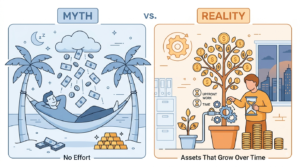
Passive Income Myths vs Reality: Side-by-Side
| What You Often Hear | What Is Actually True |
|---|---|
| “Earn money while you sleep with no effort” | Income may continue while you sleep, but building it took real effort |
| “Quit your job in 30 days” | Most passive income takes years to replace a salary |
| “No investment needed” | Every passive stream requires money, time, or both |
| “Set it and forget it forever” | Even passive income needs monitoring and occasional maintenance |
| “Anyone can do it easily” | Anyone can do it, but it requires discipline and patience |
| “Passive income is the same as a side hustle” | A side hustle trades time for money; passive income trades upfront investment for ongoing returns |
| “Real estate is always passive” | Rental property involves real ongoing work unless you pay a manager |
| “Content creates instant passive income” | Content usually takes 6 to 24 months to generate meaningful income |
The pattern is consistent: the myth removes the cost, the reality includes it. Real passive income is not a shortcut — it is a trade.
How to Build Real Passive Income: A Realistic Path
If passive income is not a quick win, what is the realistic path? It usually follows three stages:
Stage 1: Build Active Income First
Before you can build passive income, you need money or skills. For most people, that means starting with a job and a side hustle. Active income funds the investments that eventually become passive. Read our how to start a side hustle guide if you are at this stage.
Stage 2: Convert Active Income Into Assets
Once you have extra income, direct it toward assets that generate passive returns. This means investing, buying property, or building digital products and content. Each asset you build adds a small stream of income that requires less ongoing effort than your active work.
See our guide on how to start investing with little money to understand how even small monthly contributions begin building this asset base.
Stage 3: Let the Assets Compound Over Time
Passive income grows slowly at first, then accelerates as assets compound. Dividends reinvest. Content libraries grow. Properties appreciate. The key is patience — the first few years produce modest income, but the later years can produce meaningful returns if you stayed consistent.
This is also why diversification matters. Relying on one passive income source is risky. Read our guide on how to diversify your income to understand why multiple streams are more resilient than one.
Real-World Example: A 5-Year Passive Income Journey
Consider someone who starts building passive income alongside a full-time job.
Year 1 — Foundation:
- Starts a side hustle earning $400 per month
- Invests $200 per month into a diversified index fund
- Total passive income at end of year 1: roughly $20 in dividends
Year 3 — Building:
- Side hustle income increased to $700 per month
- Investment portfolio has grown to roughly $8,000
- Started a small blog that earns $50 per month in ad revenue
- Total passive income: roughly $200 in dividends + $600 in ad revenue = $800 per year
Year 5 — Compounding:
- Portfolio has grown to roughly $18,000
- Blog now earns $200 per month as the content library has grown
- Total passive income: roughly $400 in dividends + $2,400 in ad revenue = $2,800 per year
After five years, this person has roughly $2,800 per year in passive income — not enough to replace a salary, but real income that arrives with far less ongoing effort than a side hustle. The trajectory also points upward: each additional year of compounding grows the income further.
This is what realistic passive income looks like: slow, steady, and built on assets that took time and money to create.
Common Passive Income Mistakes to Avoid
- Believing the “no effort” promise: Every passive income stream required effort to build. Plan for it.
- Quitting active income too early: Passive income rarely replaces a salary quickly. Keep your active income while building.
- Chasing the latest trend: Many “new” passive income ideas are repackaged side hustles. Focus on proven models.
- Underestimating the timeline: Most passive income takes months or years to become meaningful. Patience is the strategy.
- Ignoring the upfront cost: If you cannot afford the time or money to build the asset, the income will not appear.
- Failing to diversify: Relying on one passive source is risky. Build multiple streams over time.
- Confusing passive income with a side hustle: If it requires your ongoing active time, it is not passive — it is a side hustle.
- Expecting passive income to be maintenance-free: Even passive sources need monitoring, updates, and occasional intervention.
- Skipping the active income stage: Most people need active income first to fund the assets that become passive.
- Falling for courses that sell the dream: Most passive income courses teach what is already available for free. Be skeptical of high-priced promises.
Frequently Asked Questions
What is passive income?
Passive income is money earned with minimal ongoing effort after an initial investment of time, money, or both. It is not “free money” — it is income generated by an asset you built or bought.
What is the difference between passive income and active income?
Active income requires your ongoing time and effort to earn — like a salary or freelance work. Passive income requires heavy upfront investment but continues with less ongoing effort, like dividends or rental income.
What are the most realistic passive income ideas?
The most realistic forms include dividend and investment income, rental income, digital products, content royalties, and high-yield accounts. Each requires either capital, time, or both to build.
Can I earn passive income with no money?
Some forms — like content creation and digital products — require time rather than money. But even these require significant upfront work before the income becomes passive. Most truly passive income requires at least some capital.
How long does passive income take to build?
Most passive income streams take months to years to produce meaningful income. Dividends and content income typically take the longest. Be prepared for a multi-year timeline, not weeks.
Is rental property passive income?
Rental property can become relatively passive, especially with a property manager, but it involves real ongoing work — maintenance, tenant issues, and vacancies. It is more passive than a side hustle but less passive than dividends.
Are online courses passive income?
Online courses can be relatively passive once created, but they usually require ongoing marketing to sustain sales. They are more passive than freelancing but not completely hands-off.
How does passive income fit with diversifying income?
Passive income is one type of income stream in a diversified plan. Combining active income, passive income, and side income creates resilience. Read our guide on how to diversify your income for the full picture.
Key Takeaways
- Passive income is real, but it always requires an upfront investment of money, time, or both.
- The biggest myth is that passive income is free and effortless — the reality is that building the asset takes real work.
- Genuine passive income includes dividends, rental income, digital products, content royalties, and interest income.
- Most passive income takes months or years to become meaningful; patience is the strategy.
- Active income usually comes first — it funds the assets that eventually become passive.
- Even passive income needs monitoring and maintenance; “set and forget” is a myth.
- Diversifying across multiple income streams is more resilient than relying on one.
- Be skeptical of courses and promises that sell passive income as a quick or easy path.
To continue building your income strategy, read our guide on how to diversify your income for the full picture of multiple income streams. For the foundation of passive investing income, see how to start investing with little money. And if you are still in the active income stage, our how to start a side hustle guide is where to begin.
Passive income is not a dream — it is a trade. Trade upfront effort and capital for income that eventually arrives with less of your time. Understand the trade, make it deliberately, and the income becomes real.
This article is for informational purposes only and is not financial, investment, or tax advice. Investment returns and income results vary based on market conditions, capital, effort, and location. Consult a licensed professional for advice specific to your situation.