


Health insurance is one of the few purchases where paying more up front does not always mean better protection. A high premium plan can still leave you with large bills, and a low premium plan can be surprisingly adequate if it matches how you actually use care.
That confusion is why so many people ask the same question: how much health insurance coverage do I need?
This guide walks through how to think about choosing a health plan, explains the health insurance deductible explained in plain terms, and shows you how to match a coverage level to your budget, your health, and your household — without overpaying for protection you will not use.
If you are still sorting out where health insurance fits in your overall protection plan, start with our pillar guide on the types of insurance you actually need at every life stage. This article assumes you already know you need coverage and are deciding how much.
The Core Terms You Need First
Before comparing plans, you need four terms. Almost every confusing health insurance decision becomes clearer once these are in place.
Premium
Your premium is the fixed amount you pay for coverage, usually monthly, whether you use care or not. It is the price of having the policy.
Deductible
Your deductible is the amount you pay out of pocket for covered care before the insurer begins to share costs. If your deductible is $3,000, you generally pay the first $3,000 of covered medical costs yourself each year.
A higher deductible usually means a lower premium, and vice versa. The trade-off is central to choosing a health plan.
Copay and Coinsurance
A copay is a fixed fee for a specific service, like $25 for a doctor visit. Coinsurance is a percentage of the cost of a service, like 20% of a hospital bill. Both apply after you meet your deductible.
Out-of-Pocket Maximum
This is the most you would pay in a year for covered care. Once you hit it, the insurer pays 100% of covered costs for the rest of the year. This number is the real ceiling on your financial risk.
How to Think About How Much Coverage You Need

The right amount of coverage is not the highest level available. It is the level that protects you from a cost you could not absorb on your own, at a premium you can afford to pay.
Two questions guide the decision:
- What is the worst realistic annual bill you could face? That is the role of the out-of-pocket maximum.
- What can you comfortably pay out of pocket in a normal year? That is the role of the deductible.
If a plan’s out-of-pocket maximum would bankrupt you, the coverage is too thin. If the premium is so high that you struggle to pay it, the plan is too rich for your budget. The goal is the middle — a plan where both the premium and the worst-case bill are manageable.
Plan Tiers: Bronze, Silver, Gold, and Beyond
Many individual markets group plans into tiers. These tiers describe how costs are split between you and the insurer, not the quality of care.
| Plan Tier | Typical Premium | Typical Deductible | Best For |
|---|---|---|---|
| Bronze | Lowest | Highest | People who rarely use care and want protection against major bills only |
| Silver | Moderate | Moderate | People who use some care and want a balance |
| Gold | Higher | Lower | People who use care regularly and prefer predictable costs |
| Platinum (or equivalent) | Highest | Lowest | People with frequent or high-cost medical needs |
A lower-tier plan is not automatically worse. If you are healthy and have enough savings to cover the deductible, a Bronze plan can be the smarter financial choice — you pay less each month and accept more risk only in years you actually need care.
How Your Health Situation Should Shape the Choice
The same plan can be ideal for one person and a poor fit for another. Your expected use of care should drive the decision more than the tier name.
If You Rarely See a Doctor
A high-deductible plan with a low premium often makes sense. You pay less each month, and your main protection is against a major event like surgery or hospitalization. Pairing it with a health savings account, if available, can let you save for future medical costs with tax advantages.
If You Have Ongoing Care Needs
A plan with a lower deductible and higher premium often costs less overall. If you take regular prescriptions, see specialists, or have a chronic condition, you are likely to hit the deductible quickly — and a higher premium that reduces your per-visit costs can be the cheaper path across a full year.
If You Have a Family
Family coverage adds complexity because multiple people can use care. A moderate-deductible plan often works well because the odds that someone in the household will need care during the year are higher. Review whether one family plan is cheaper than separate plans, and whether all your regular providers are in-network.
If You Are Approaching Retirement
Healthcare use tends to rise with age, and planning for the transition to government senior health programs matters. A plan with a lower deductible and stronger drug coverage may reduce your out-of-pocket costs in the years leading up to that transition.
How the Deductible Really Works
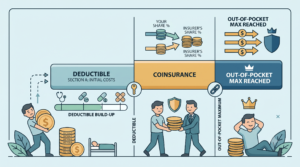
Suppose you have a plan with a $3,000 deductible, 20% coinsurance, and a $6,000 out-of-pocket maximum.
- You pay the first $3,000 of covered costs yourself. This is the deductible.
- After that, you pay 20% of covered costs (coinsurance) while the insurer pays 80%.
- If your covered costs are high enough that your share reaches $6,000 in a year, you stop paying. The insurer covers 100% of covered costs for the rest of the year.
This is why the out-of-pocket maximum, not the deductible alone, is the number that tells you how much coverage you really have. A plan with a $2,000 deductible and a $10,000 maximum exposes you to more risk than a plan with a $5,000 deductible and a $5,000 maximum.
When comparing plans, always look at the worst-case number first.
Employer Plan vs Individual Plan
If you have access to an employer plan, it is often the simplest starting point because the employer typically pays part of the premium. But it is not always the cheapest option for your household.
Compare the total cost across a year:
- Your share of the employer plan premium
- The deductible and out-of-pocket maximum
- Whether your regular doctors and prescriptions are covered
- Whether a spouse’s plan or an individual plan offers similar coverage for less
For families, it is common to find that covering everyone on one employer plan is more expensive than splitting coverage across two plans. Run the full-year math before defaulting to one approach.
Real-World Example: Three Households, Different Choices
Consider three households choosing coverage for the year.
Household A — Single, healthy, age 28:
- Expected care: one annual checkup
- Choice: Bronze plan, $3,500 deductible, low premium
- Why: Low expected use makes the low premium the better deal; the deductible is covered by savings
Household B — Family of four, two young children:
- Expected care: pediatric visits, a few sick visits, possible urgent care
- Choice: Silver plan, $2,500 deductible, moderate premium
- Why: Moderate expected use makes the balanced plan cheaper across a full year
Household C — Couple, one spouse with a chronic condition:
- Expected care: regular prescriptions and specialist visits
- Choice: Gold plan, $1,000 deductible, higher premium
- Why: High expected use means the lower deductible and lower per-visit costs save more than the premium difference
No single tier is right for all three. The right coverage level depends on expected use, not on a label.
Common Health Insurance Mistakes to Avoid
- Choosing only on premium: A cheap premium can hide a high deductible and a high out-of-pocket maximum.
- Ignoring the out-of-pocket maximum: This number, not the deductible, is the real ceiling on your risk.
- Assuming the highest tier is always best: Gold or Platinum plans cost more each month and may not save money if you rarely use care.
- Forgetting to check the network: A plan is worth little if your regular doctors are not in-network.
- Overlooking prescription coverage: Drug costs vary widely between plans; check the formulary before enrolling.
- Underinsuring to save money: A plan whose maximum would bankrupt you is too thin, even if the premium is low.
- Not reviewing annually: Plans change costs, networks, and formularies each year; last year’s best fit may not be this year’s.
- Skipping coverage because you are healthy: One major event can create a bill larger than years of premiums.
Frequently Asked Questions
How much health insurance coverage do I need?
You need enough coverage that the worst-case annual bill (the out-of-pocket maximum) would not derail your finances, at a premium you can comfortably afford each month. The exact level depends on your health, budget, and household size.
What is a health insurance deductible?
A deductible is the amount you pay out of pocket for covered care before the insurer begins sharing costs. A higher deductible usually means a lower monthly premium, and vice versa.
Is a high-deductible plan a bad idea?
Not necessarily. If you are healthy and have savings to cover the deductible, a high-deductible plan with a low premium can be the cheaper choice across a normal year. It becomes costly only if you need significant care.
What is the out-of-pocket maximum and why does it matter?
It is the most you would pay for covered care in a year. Once you reach it, the insurer pays 100% of covered costs. It is the most important number for understanding your real financial risk.
Should I pick the plan with the lowest premium?
Only if its deductible and out-of-pocket maximum are also manageable for you. A low premium with a very high maximum can leave you exposed to a large bill if you need serious care.
Are Gold or Platinum plans always better?
No. They offer lower deductibles and more predictable costs, but the higher premium only pays off if you use care often enough to offset it. For healthy people with low expected use, a lower tier is often cheaper overall.
How does health insurance fit with my emergency fund?
Your emergency fund should be large enough to cover your out-of-pocket maximum or at least your deductible, so a medical event does not become a cash crisis. Read our emergency fund guide to see how to size that buffer.
Should I keep life insurance in mind when choosing health coverage?
They protect different risks, but both are part of a complete protection plan. See our term life vs whole life insurance comparison to understand the life-coverage side.
Key Takeaways
- The right coverage level protects you from a bill you could not absorb, at a premium you can afford.
- The out-of-pocket maximum, not the deductible alone, is the real measure of how much risk you carry.
- Higher-tier plans are not automatically better; they only pay off when your expected use of care is high.
- High-deductible plans can be smart for healthy people who have savings to cover the gap.
- Always check the network and prescription formulary, not just the premium and deductible.
- Match the plan tier to your expected medical use, not to a label or a price tag.
- Review your plan annually because costs, networks, and drug coverage change each year.
To see where health insurance fits in your full protection plan, read our pillar guide on the types of insurance you actually need at every life stage. For the life-coverage side, see our term life vs whole life insurance comparison, and for the cash side of a medical emergency, read our emergency fund guide.
The right amount of health insurance is not the most you can buy — it is the amount that keeps a major medical event from becoming a financial disaster, at a monthly cost you can sustain.
This article is for informational purposes only and is not financial or insurance advice. Coverage needs, costs, and plan availability vary by individual, location, age, health, and provider. Review specific policy terms with a licensed professional before enrolling.