


If you have started looking into life insurance, you have probably noticed the same two options appearing everywhere: term life and whole life.
One is often described as simple and affordable. The other is described as lifelong protection with a savings component. Advertisements, agents, and blog posts rarely agree on which one is better, and that confusion is exactly why so many beginners end up with the wrong policy.
This life insurance comparison breaks down term life vs whole life insurance in plain language. You will see how each one works, how the costs differ, and which type fits different situations — so you can choose the best life insurance for beginners without paying for coverage you do not need.
If you are still deciding whether you need life insurance at all, start with our pillar guide on the types of insurance you actually need at every life stage. This article assumes you have already decided that life insurance makes sense for your situation.
What Is Term Life Insurance?
Term life insurance pays a fixed amount to your beneficiaries if you die during a specific period, called the term.
The term is usually 10, 15, 20, or 30 years. If you outlive the term, the policy simply ends and no payout is made. There is no cash value, no savings component, and no investment feature — it is purely protection.
Because the coverage is temporary and has no cash value, premiums are usually much lower than whole life for the same payout amount. A healthy person in their 30s can often secure hundreds of thousands of dollars in coverage for a modest monthly cost.
The main limitations are that the policy expires at the end of the term, and premiums can rise sharply if you renew or buy a new policy later in life when your age and health have changed.
Key Features of Term Life
- Fixed payout amount (death benefit)
- Fixed term length, typically 10 to 30 years
- Level premiums that stay the same for the full term
- No cash value or savings component
- Ends if you outlive the term
What Is Whole Life Insurance?
Whole life insurance is a type of permanent life insurance. It is designed to last your entire life, as long as you keep paying the premiums.
It combines two things: a death benefit and a cash value component. Part of each premium pays for the insurance coverage, and part goes into a cash value account that grows over time, often at a guaranteed minimum rate.
The cash value belongs to you and can typically be borrowed against or withdrawn from, though loans and withdrawals can reduce the death benefit if not repaid.
Because whole life guarantees lifetime coverage and builds cash value, premiums are significantly higher than term life — often five to ten times more for the same death benefit.
Key Features of Whole Life
- Lifetime coverage, as long as premiums are paid
- Fixed premiums that do not increase with age
- Guaranteed death benefit
- Cash value that grows over time
- Ability to borrow against or withdraw from cash value
Term Life vs Whole Life Insurance: Side-by-Side Comparison
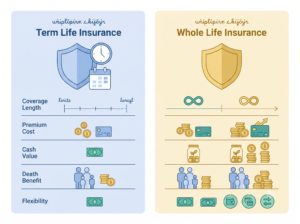
| Feature | Term Life | Whole Life |
|---|---|---|
| Coverage length | Fixed term (10–30 years) | Lifetime |
| Premium cost | Lower | Much higher |
| Premium stability | Level for the term | Level for life |
| Death benefit | Fixed | Fixed (guaranteed) |
| Cash value | None | Yes, grows over time |
| Borrowing option | No | Yes, against cash value |
| Best for | Temporary income protection | Lifelong needs with savings |
| Complexity | Simple | More complex |
The comparison comes down to this: term life is designed to cover a temporary need at the lowest cost, while whole life is designed to cover a permanent need and double as a savings vehicle — at a much higher cost.
How the Costs Really Compare
The price gap between term and whole life is large enough that it should be the first thing you look at.

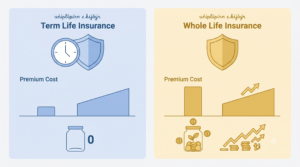
Suppose a healthy 35-year-old wants $500,000 of coverage.
- A 20-year term policy might cost roughly $25 to $40 per month.
- A whole life policy for the same $500,000 might cost roughly $250 to $450 per month.
Over 20 years, that difference adds up to tens of thousands of dollars.
The whole life policy does build cash value, but that growth is slow in the early years because much of the premium covers insurance costs and fees. The cash value often takes many years to equal what you have paid in.
A common strategy, sometimes called “buy term and invest the rest,” is to buy a term policy for protection and invest the premium difference yourself. Whether that produces a better result depends on the returns you earn, the fees involved, and your discipline — but for many beginners, the lower cost of term life frees up money for retirement contributions, debt repayment, or an emergency fund.
Read our emergency fund guide to see how that freed-up cash can strengthen your overall financial plan.
When Term Life Usually Makes Sense
Term life is the right fit for most people who need life insurance for a defined period.
It typically makes sense when:
- You want to replace your income while children are young
- You have a mortgage that will be paid off in 15 to 30 years
- You have debts that would fall to someone else if you died
- Your dependents will eventually become financially independent
- You want the most coverage per dollar spent
The logic is simple: the financial obligation you are protecting has an end date, so the insurance can have an end date too.
For example, if you have a 20-year mortgage and a young child, a 20-year term policy can cover the years when losing your income would cause the most damage. Once the mortgage is gone and your child is independent, the need for that coverage may disappear.
When Whole Life Might Make Sense
Whole life is not the right default for most beginners, but it can fit specific situations.
It may make sense when:
- You have a lifelong dependent, such as a child with special needs
- You expect to owe estate taxes and want liquidity to cover them
- You have maxed out other tax-advantaged savings and want another vehicle
- You want guaranteed lifelong coverage and can comfortably afford the premiums
- You value forced savings and are unlikely to invest the difference on your own
Whole life is a long-term commitment. Surrendering the policy early can come with significant fees and may return less than you paid in. It is usually not suitable if you are unsure you can maintain the premiums for many years.
How to Choose Without Overpaying
A few steps help most beginners avoid the wrong choice:
- Identify the need first. Who depends on your income, and for how long? If the need is temporary, term is usually the better match.
- Compare quotes for both. Seeing the actual premium difference for your age and health makes the decision concrete.
- Check the term length against your obligations. Match the term to your mortgage, your children’s independence timeline, or your retirement plan.
- Consider employer coverage separately. Workplace life insurance is useful but usually ends when you leave the job, so it should not be your only coverage.
- Do not buy based on the cash value pitch alone. The savings feature sounds attractive, but it comes at a high cost that may not suit your goals.
If you are also reviewing your broader protection plan, our guide on how much health insurance coverage you actually need covers the health side of the same decision.
Real-World Example: Term vs Whole for the Same Household
Consider a 35-year-old with a working partner, a young child, and a 20-year mortgage who wants $500,000 of coverage.
Option A — 20-year term policy:
- Premium: roughly $30 per month
- Total cost over 20 years: roughly $7,200
- Cash value at year 20: none
- Coverage ends at age 55, around when the mortgage is paid off
Option B — Whole life policy:
- Premium: roughly $350 per month
- Total cost over 20 years: roughly $84,000
- Cash value at year 20: some, but likely still below total premiums paid
- Coverage continues for life if premiums continue
The term policy provides the same $500,000 protection for a fraction of the cost during the years the household needs it most. The difference — roughly $76,800 over 20 years — could be directed toward retirement savings, debt, or an emergency fund.
This does not make whole life wrong for everyone. It shows why the choice should start with the need, not the product.
Common Life Insurance Mistakes to Avoid
- Buying whole life before checking if term fits the need: Many people pay far more than necessary for coverage that does not match their situation.
- Buying too little term coverage: A small policy may not replace your income long enough for your dependents.
- Choosing a term that is too short: A 10-year term may expire while your children still depend on you.
- Ignoring the cost difference: The gap between term and whole life premiums can be tens of thousands of dollars over time.
- Relying only on employer life insurance: Workplace coverage usually ends when you change jobs.
- Surrendering whole life early: Early surrender can trigger fees and return less than you paid in.
- Mixing insurance and investing without understanding the cost: The cash value feature has value, but it is not free.
- Skipping coverage entirely because it feels complicated: For most people, a simple term policy is affordable and straightforward.
Frequently Asked Questions
What is the main difference between term and whole life insurance?
Term life covers you for a fixed period and has no cash value. Whole life covers you for your entire life and builds cash value, but costs much more.
Is whole life insurance worth it?
For most beginners, term life covers the same need at a much lower cost. Whole life can make sense for specific lifelong needs, but it is usually not the right default.
How much cheaper is term life than whole life?
Term life is often five to ten times cheaper than whole life for the same death benefit, depending on your age, health, and the term length.
What happens if I outlive my term policy?
The policy ends and no payout is made. You can often renew, convert to permanent coverage, or buy a new policy, but premiums will be higher based on your age and health at that time.
Can I borrow from a term life policy?
No. Term life has no cash value, so there is nothing to borrow against. Borrowing is available with whole life and other permanent policies that build cash value.
Should I buy term and invest the rest?
This strategy works for many people, but the result depends on your investment returns, fees, and discipline. Compare the realistic outcomes before assuming it is always better.
Is life insurance from my employer enough?
It is a useful benefit, but it usually ends when you leave the job and may not be enough to fully protect your dependents. Consider owning a separate policy for coverage you control.
Does whole life build cash value from the start?
Cash value grows slowly in the early years because much of the premium covers insurance costs and fees. It typically takes several years before the cash value equals what you have paid in.
Key Takeaways
- Term life covers a fixed period at a low cost and has no cash value.
- Whole life covers your entire life and builds cash value, but costs much more.
- For most beginners with a temporary need, term life provides the same protection for a fraction of the price.
- Whole life can fit specific lifelong needs, such as a lifelong dependent or estate planning.
- Match the term length to your financial obligations, like a mortgage or your children’s independence.
- The premium difference between term and whole life can be redirected to retirement savings, debt, or an emergency fund.
- Start with the need, then choose the product — not the other way around.
To understand where life insurance fits in your overall protection plan, read our pillar guide on the types of insurance you actually need at every life stage. For the health side of your coverage, see how much health insurance coverage you actually need, and for the cash side, read our emergency fund guide.
The best life insurance for beginners is rarely the most expensive one — it is the one that covers the right risk, for the right length of time, at a price you can comfortably sustain.
This article is for informational purposes only and is not financial or insurance advice. Coverage needs and costs vary by individual, location, age, health, and provider. Review specific policy terms with a licensed professional before purchasing.