


Insurance is one of the most confusing parts of personal finance. There are dozens of policy types, hundreds of providers, and a constant stream of advertisements telling you that you need more coverage than you probably do.
A good insurance guide for beginners starts with one simple idea: insurance exists to protect you from costs that would otherwise derail your finances. It is not meant to cover every small expense — it is meant to cover the losses you could not easily recover from on your own.
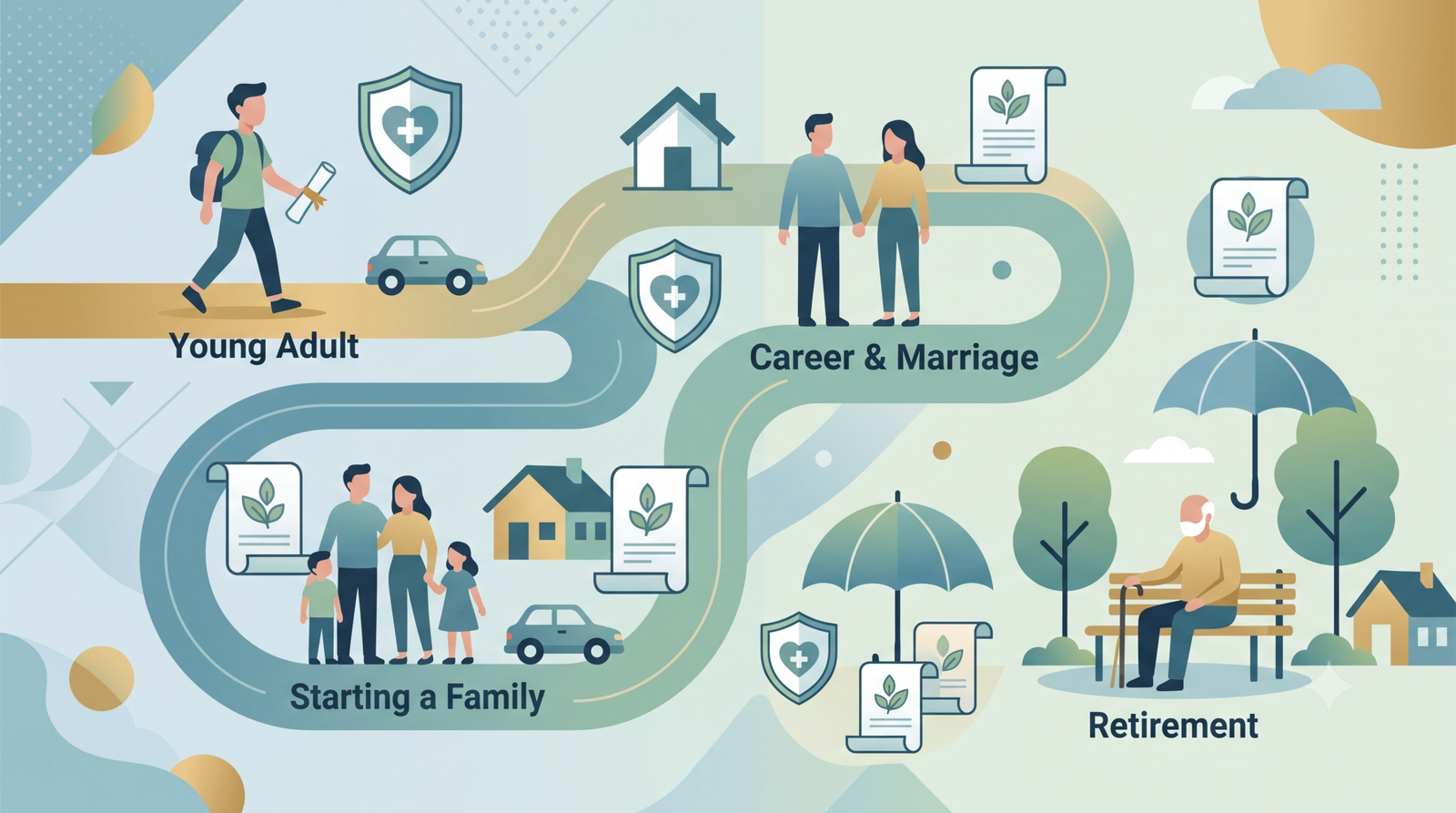
This article walks through the types of insurance you need at each stage of life, which essential insurance policies make sense for most people, and which ones you can often skip or delay. Your needs change as you move from your first job to starting a family to approaching retirement, so the right mix is rarely the same for two decades in a row.
You will also see how insurance fits alongside cash savings. A strong emergency fund and the right policies work together, so this guide connects to our emergency fund guide for the cash side of the same problem.
What Insurance Actually Does
Insurance transfers financial risk from you to an insurer.
Instead of paying the full cost of a major loss — a hospital stay, a car accident, a house fire, or the loss of a primary earner — you pay a smaller, predictable amount called a premium. In exchange, the insurer agrees to cover certain costs if a covered event happens.
The core trade-off is simple: you accept a small certain cost (the premium) to avoid a small chance of a very large cost (the loss). This means insurance is most valuable when a loss would be catastrophic to your finances, and least valuable when a loss would be minor or easy to absorb. That single principle explains why some policies are essential and others are optional.
Three terms you will see throughout this guide:
- Premium: the amount you pay for coverage, usually monthly or annually.
- Deductible: the amount you pay out of pocket before the insurer begins to pay.
- Coverage limit: the maximum the insurer will pay for a covered loss.
Understanding these three terms makes almost every policy easier to compare.
How Insurance Needs Change Over Time
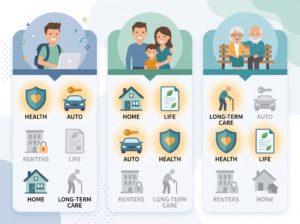
Your insurance needs are not static. They shift as your income, responsibilities, dependents, and assets change. The table below summarizes the typical coverage priorities at each stage. Treat it as a starting point, not a universal rule.
| Life Stage | Usually Essential | Often Worth Considering | Usually Optional |
|---|---|---|---|
| Young adult, single, no dependents | Health, auto (if you drive), renters | Disability insurance (if employed) | Life insurance, umbrella |
| Married, young children | Health, auto, term life, disability | Homeowners (if buying), umbrella | Whole life, credit insurance |
| Mid-career, growing assets | Health, auto, term life, home, umbrella | Long-term disability, long-term care | Identity-theft add-ons |
| Pre-retirement | Health, auto, home, umbrella | Long-term care planning | Credit life, extended warranties |
| Retirement | Health (Medicare + supplements), auto, home | Long-term care, final expense | Term life (often no longer needed) |
Notice that as assets grow, the case for liability protection (like an umbrella policy) grows too. As dependents leave and debts shrink, the case for life insurance often shrinks.
Insurance in Your 20s and Early 30s
At this stage, most people have fewer dependents and fewer assets, but they are not immune to financial disasters.
Health Insurance
A single unexpected hospital visit can produce a bill larger than many young adults earn in a year. Health insurance is usually the most important coverage at this stage, even if you are healthy. Options often include a parent’s plan (frequently available until age 26 in many markets), an employer plan, or an individual plan. Compare the monthly premium against the deductible and out-of-pocket maximum, not just the sticker price.
Read our guide on how much health insurance coverage you actually need to compare plan tiers without overpaying.
Auto Insurance
If you drive, auto insurance is usually legally required and financially essential. Beyond the minimum, consider whether the value of your vehicle justifies comprehensive and collision coverage. Our car insurance guide explains how rates are calculated and which factors you can actually change.
Renters Insurance
Renters insurance is one of the most underused policies. It typically costs far less than people expect and covers your belongings, temporary housing, and personal liability. Many renters skip it because they assume their landlord’s insurance covers their things — it usually does not. See our full breakdown on whether you need renters or homeowners insurance.
Disability Insurance
If you rely on your income and have no dependents, your ability to earn is your most valuable asset. Disability insurance replaces a portion of your income if you cannot work due to illness or injury. Long-term disability is often more valuable than life insurance for a single person, because you are statistically more likely to experience a disabling illness than to die during your working years.
Life Insurance: Usually Optional Here
If nobody depends on your income, life insurance is often not a priority in your 20s. The main exception is shared debt — for example, a mortgage co-signed with a partner — where your death would leave someone else responsible.
Insurance When You Have a Family
This is the stage where insurance needs usually expand the most. Other people now depend on your income and your presence.
Term Life Insurance
If anyone depends on your income — a partner, children, or aging parents — term life insurance is typically the most cost-effective way to protect them. It pays a set amount if you die during a defined period (the term), often 10 to 30 years, and is usually far cheaper than whole life insurance for the same coverage amount. Our comparison of term life vs whole life insurance breaks down the costs and trade-offs side by side so you do not overpay for the wrong structure.
Disability Insurance Becomes Critical
With a family, losing your income to illness or injury is even more damaging. Review the replacement percentage and the definition of disability. “Own-occupation” coverage is usually more protective than “any-occupation” coverage, though it costs more.
Homeowners Insurance and Umbrella Liability
If you buy a home, your lender will usually require homeowners insurance; even without a lender, the coverage protects what is likely your largest asset. As your income and assets grow, you also become a more attractive target for liability claims. An umbrella policy adds liability coverage on top of your auto and home policies at a relatively low cost.
Insurance in Mid-Career and Pre-Retirement
At this stage, your assets are larger, your income may be near its peak, and your time horizon for some risks is shorter.
Review Term Life Coverage
If you bought a 20- or 30-year term in your 30s, check whether it still matches your obligations. As children become independent and debts shrink, you may need less coverage — or you may need to extend if obligations remain.
Long-Term Care Planning
Long-term care — help with daily living due to age, illness, or disability — is one of the largest uninsured risks for many households, and is often not covered by standard health insurance. Planning options include traditional long-term care insurance, hybrid life policies with a long-term care benefit, or dedicated savings.
Keep Coverage Strong and Maintain the Cash Buffer
Do not let coverage drift as life gets busy. Re-check health plan choices annually, confirm umbrella limits still match your net worth, and keep your emergency fund aligned with your higher deductible limits so a claim does not create a separate crisis. Our emergency fund guide shows how to size that buffer.
Insurance in Retirement
In retirement, the priority shifts from protecting income to protecting assets and managing healthcare costs.
Many people transition to government health programs for seniors, often supplemented by private plans — review coverage annually, because plan options and costs change. If your dependents are financially independent and your debts are cleared, the original purpose of life insurance may no longer apply; some retirees keep only a small policy for final expenses. Long-term care remains a key risk, so address it before health changes limit availability. Retirees often drive less and own homes outright, but the underlying risks remain — adjust coverage to reflect actual usage while keeping liability protection in place.
Real-World Example: One Household Across Three Stages
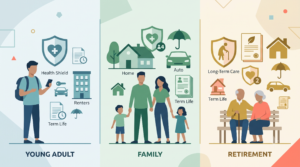
Consider a hypothetical household to see how the insurance mix shifts.
Stage 1 — Age 25, single, renting, first job:
- Health insurance through employer
- Auto insurance (liability plus modest collision)
- Renters insurance at a low monthly cost
- No life insurance — no dependents
- Emergency fund: building toward one month of expenses
Stage 2 — Age 38, married, two children, homeowner:
- Family health plan
- Auto insurance with higher liability limits
- Term life insurance on both earners, sized to replace income through the children’s independence
- Long-term disability on the primary earner
- Homeowners insurance with dwelling limits matched to rebuild cost
- Umbrella policy added as assets grow
- Emergency fund: three to six months of expenses
Stage 3 — Age 67, retired, mortgage paid, adult children:
- Government senior health plan plus a supplement
- Auto insurance adjusted for lower mileage
- Homeowners insurance retained, limits reviewed
- Large term life policy allowed to expire; a small final-expense policy kept
- Long-term care planning addressed years earlier
- Emergency fund: maintained for deductibles and gaps
The policies changed, but the logic stayed the same: cover the catastrophic losses, skip the minor ones, and adjust as responsibilities change.
Common Insurance Mistakes to Avoid
- Buying insurance for small, absorbable costs: Extended warranties and low-value add-ons often cost more than the risk they cover.
- Skipping the essentials to save on premiums: Dropping health or auto coverage to save money can create a far larger loss.
- Underinsuring your home’s rebuild cost: Insuring for market value rather than rebuild cost can leave a gap after a total loss.
- Buying whole life when term fits your need: Whole life costs significantly more and may not match a simple income-protection goal.
- Ignoring disability insurance: For working-age people, a disabling illness is often a more likely risk than early death.
- Letting coverage stay the same for decades: Needs change; a policy that fit at 30 may be wrong at 55.
- Choosing only on premium price: The cheapest policy may have low limits, high deductibles, or excluded coverage.
- Confusing insurance with investing: Some policies mix coverage with investment; understand the cost of that combination before buying.
Frequently Asked Questions
What types of insurance do I actually need?
Most adults need health insurance, auto insurance if they drive, and property coverage (renters or homeowners). Life and disability insurance become important when others depend on your income. The exact mix depends on your life stage and responsibilities.
What is the most important insurance for a beginner?
For most people, health insurance is the highest priority because a single major medical event can create a cost larger than years of income. Auto insurance is usually essential if you drive, and renters insurance is inexpensive and often overlooked.
Do I need life insurance if I am single with no dependents?
Often, no. The main exceptions are shared debts that would pass to someone else, or a desire to cover final expenses. Without dependents relying on your income, term life insurance is usually a low priority.
Is whole life insurance worth it?
For many people, term life insurance covers their need at a much lower cost. Whole life combines coverage with a cash-value component, which can make sense in specific situations but is more expensive and more complex. Compare the two before deciding.
When should I add umbrella insurance?
Umbrella insurance usually becomes worth considering when your assets or income make you a meaningful target for a liability claim, or when your auto and home liability limits feel too low relative to your net worth.
Should I keep life insurance in retirement?
Often, large term policies are no longer needed once dependents are independent and debts are cleared. Some retirees keep a small policy for final expenses or legacy reasons, but the original income-protection purpose usually no longer applies.
How does insurance work with my emergency fund?
Insurance covers catastrophic losses; your emergency fund covers deductibles, gaps, and short-term costs that insurance does not. The two work together — raising a deductible can lower your premium, but only if your cash buffer can absorb the higher out-of-pocket amount.
Key Takeaways
- Insurance protects you from catastrophic losses, not from every small expense.
- The types of insurance you need change at every life stage — there is no single lifelong policy mix.
- Health and auto coverage are usually essential early; life and disability insurance become critical when others depend on your income.
- Term life insurance is typically the most cost-effective way to protect dependents.
- As assets grow, add liability protection such as an umbrella policy.
- In retirement, the focus shifts to healthcare, long-term care, and asset protection rather than income replacement.
- Pair insurance with a cash buffer so deductibles and gaps do not create a separate crisis.
To go deeper, continue with our guides on term life vs whole life insurance, how much health insurance coverage you actually need, how car insurance rates are calculated, and whether you need renters or homeowners insurance. For the cash side of protecting yourself, read our emergency fund guide.
The right insurance plan is not the one with the most policies — it is the one that covers your real risks at each stage of life, without paying for protection you do not need.
This article is for informational purposes only and is not financial or insurance advice. Coverage needs vary by individual, location, and provider. Review specific policy terms with a licensed professional before purchasing.