


Car insurance is one of those bills most people pay without fully understanding. You get a quote, the number seems reasonable or it doesn’t, and you either switch providers or stay put. Rarely does anyone explain why the number is what it is.
That matters because understanding how car insurance rates are calculated is the first step to lowering them. Rates are not pulled from thin air — they are built from a set of car insurance factors that insurers use to predict how likely you are to file a claim. Some of those factors you can change, and some you cannot.
This guide explains how insurers set your price, which factors matter most, and practical, proven methods for how to lower car insurance without sacrificing the protection you actually need.
If you are still deciding whether you need car insurance at all, our pillar guide on the types of insurance you actually need at every life stage covers where it fits in your broader protection plan.
What Car Insurance Actually Covers
Before looking at how rates are set, it helps to know what you are paying for. A standard auto policy is not one coverage — it is usually a bundle of several parts.
Liability Coverage
This pays for damage and injuries you cause to others. It is legally required in most places, and it is the part of the policy you should never underinsure, because the costs of an at-fault accident can be enormous.
Collision Coverage
This pays for damage to your own vehicle after a crash, regardless of fault. It is optional if you own the car outright, and usually required if you have a loan or lease.
Comprehensive Coverage
This pays for damage not caused by a collision — theft, vandalism, weather, fire, falling objects, or hitting an animal. Like collision, it is often required with a loan or lease.
Other Common Add-Ons
- Personal injury protection: covers medical costs for you and your passengers
- Uninsured/underinsured motorist: protects you if the other driver has no or little coverage
- Roadside assistance: covers towing, lockouts, and flat tires
Each of these components is priced separately, which is why two people with the same “full coverage” label can pay very different amounts.
How Car Insurance Rates Are Calculated
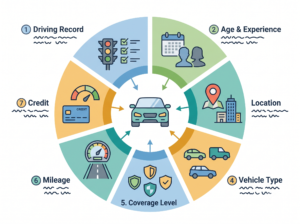
Insurers build your rate by estimating the likelihood and cost of a future claim. They use historical data across millions of drivers and apply that to your specific profile.
Your Driving Record
This is usually the single most important factor. Accidents, tickets, claims, and DUIs can raise your rate significantly, and they often stay on your record for three to five years. A clean record, by contrast, often qualifies you for the best available pricing.
Your Age and Experience
Young and newly licensed drivers pay the most, because the data shows they file claims more often. Rates typically drop in your mid-20s and again around 30, then often stay stable until senior years, when they may rise slightly.
Your Location
Where you live and where the car is parked affects your rate. Denser areas with more traffic, higher theft rates, or more weather claims tend to produce higher premiums. Even moving a few miles can change your price.
Your Vehicle
Some vehicles cost more to repair, are stolen more often, or cause more damage in a crash. Insurers track all of this. A car with strong safety ratings and low repair costs is usually cheaper to insure than a high-performance or luxury vehicle.
Your Coverage Level and Deductibles
The more coverage you buy and the lower your deductibles, the higher your premium. Raising your deductible is one of the simplest ways to lower your monthly cost — but only if you could afford to pay that deductible if you needed to.
Your Mileage
Drivers who log fewer miles are less likely to be in an accident, so low-mileage drivers often pay less. Some insurers offer usage-based programs that track driving and offer discounts for safe, low-mileage habits.
Your Credit-Based Insurance Score
In many markets, insurers use a credit-based score as one factor in setting rates. The data shows a correlation between stronger credit and fewer claims. This factor is not allowed everywhere, so its impact depends on where you live.
Claims History
A history of filing frequent claims, even small ones, can signal higher risk. Some insurers raise rates after a single claim; others only react to multiple claims within a short period.
The Factors You Can Change vs the Ones You Cannot
Some of the factors above are fixed; others are within your control. Knowing the difference helps you focus your effort where it actually moves the price.
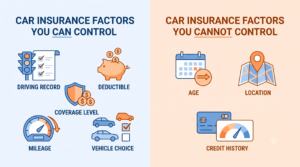
| Factors You Usually Cannot Change | Factors You Usually Can Change |
|---|---|
| Age and years of driving experience | Driving record (by driving safely over time) |
| Where you live | Coverage level and deductibles |
| Gender (in markets where it is used) | Vehicle choice when you next buy |
| Past accidents already on your record | Annual mileage and driving habits |
| Credit history (improves slowly) | Which insurer you choose |
| Local claim trends | Bundling and discounts |
The point is not to worry about the fixed factors. The point is to act on the ones you control, because several of them have a real impact on your premium.
How to Lower Car Insurance: Practical Methods
Now the actionable part. These are the methods most likely to reduce your premium without leaving you underprotected.
Shop Around Regularly
Insurers do not all price risk the same way. The same driver can get meaningfully different quotes from different companies. Comparing quotes from at least three insurers every year or two is one of the highest-impact steps you can take.
Raise Your Deductible
Moving from a $250 deductible to $500 or $1,000 can lower your premium noticeably. The trade-off is that you pay more out of pocket if you file a claim, so this only makes sense if your emergency fund can absorb the higher amount. See our emergency fund guide to size that buffer.
Drop Coverage You No Longer Need
If your vehicle is older and its market value is low, collision and comprehensive coverage may cost more than the car is worth. Compare the annual cost of those coverages against the vehicle’s value. If the premium over a year or two would exceed the payout after a total loss, dropping them may make sense.
Bundle Policies
Many insurers offer a discount when you carry multiple policies with them — for example, auto and homeowners or renters insurance. See our guide on whether you need renters or homeowners insurance to understand the property side of a bundle.
Ask About Discounts You May Be Missing
Common discounts include safe driver, low mileage, multi-vehicle, good student, defensive driving course, paperless billing, and automatic payment. Insurers do not always apply these automatically, so ask directly.
Improve Your Driving Record Over Time
Accidents and tickets age out of your record, usually after three to five years. The longer you go without an incident, the more your rate can improve. A clean record is both the best safety practice and the best pricing strategy.
Reduce Your Mileage
If you start working from home, carpool, or move closer to work, tell your insurer. Lower annual mileage can qualify you for a lower rate, especially in usage-based programs.
Improve Your Credit
In markets where credit-based insurance scoring is used, improving your credit over time can contribute to lower premiums. It is not an overnight fix, but it is one more reason stronger credit pays off across your finances.
Real-World Example: Lowering a $1,800 Annual Premium
Consider a driver paying $1,800 per year for full coverage on a mid-size vehicle.
Step 1 — Shop around: Gets a comparable quote for $1,500 from another insurer. Saves $300.
Step 2 — Raise deductible from $250 to $1,000: Lowers the new premium to $1,350. Saves another $150, with the understanding that they must be able to cover $1,000 out of pocket.
Step 3 — Ask about discounts: Discovers a low-mileage and paperless discount worth $75. Premium drops to $1,275.
Step 4 — Review vehicle value: The car is eight years old and worth about $4,000. Collision and comprehensive cost roughly $300 per year combined. The driver keeps them for now, but marks a reminder to re-evaluate next year when the value drops further.
Total annual savings: $525, or roughly 29%, without reducing liability coverage. The key was acting on the factors within control and leaving the liability protection intact.
Common Car Insurance Mistakes to Avoid
- Letting coverage auto-renew without comparing: Loyalty to one insurer does not always pay; rates drift over time.
- Underinsuring liability to save money: The most expensive part of an at-fault accident is often the other party’s costs, not your own car.
- Choosing a deductible you cannot afford: A high deductible saves on premium but creates a cash crisis if you cannot pay it.
- Keeping full coverage on a low-value car: Collision and comprehensive on a car worth a few thousand dollars may cost more than it returns.
- Ignoring discounts: Insurers do not always apply every discount automatically; asking can unlock savings.
- Filing small claims: A minor claim can raise your rate for years; paying a small repair out of pocket may be cheaper long-term.
- Assuming the cheapest quote is best: Compare coverage limits and deductibles, not just the price.
- Forgetting to update your insurer after life changes: Moving, changing jobs, or reducing mileage can all affect your rate.
Frequently Asked Questions
How are car insurance rates calculated?
Insurers estimate the likelihood and cost of a future claim using factors like your driving record, age, location, vehicle, coverage level, mileage, and credit-based score. Each factor is weighted differently by each company, which is why quotes vary.
What affects car insurance the most?
Your driving record is usually the most powerful factor. Accidents, tickets, and claims can raise your rate significantly, while a clean record often earns the best pricing.
How can I lower my car insurance premium?
Shop around regularly, raise your deductible if you can afford it, drop unnecessary coverage on older vehicles, bundle policies, ask about discounts, and maintain a clean driving record.
Does my credit score affect my car insurance?
In many markets, insurers use a credit-based insurance score as one factor. The correlation between stronger credit and fewer claims is why it matters. This practice is not allowed everywhere, so its impact depends on where you live.
Should I drop full coverage on an older car?
It depends on the vehicle’s value. If the annual cost of collision and comprehensive coverage approaches the car’s value over a year or two, dropping them may make sense. Keep liability coverage regardless.
How often should I compare car insurance quotes?
At least every one to two years, and whenever you have a life change like moving, buying a car, or adding a driver. Quotes take minutes and can reveal significant savings.
Is a higher deductible always better?
Not always. A higher deductible lowers your premium but increases your out-of-pocket cost in a claim. It only makes sense if your emergency fund can cover the higher amount.
Does bundling really save money?
For many households, yes. Combining auto with homeowners or renters insurance often produces a discount on both policies. Compare the bundled price against separate policies to confirm the savings are real.
Key Takeaways
- Car insurance rates are calculated from factors that predict your likelihood and cost of filing a claim.
- Your driving record is usually the most powerful factor; a clean record earns the best pricing.
- Some factors, like age and location, are fixed; others, like deductibles, mileage, and coverage level, are within your control.
- Shopping around regularly is one of the highest-impact ways to lower your premium.
- Raising your deductible saves money, but only if you can afford the higher out-of-pocket cost.
- Drop collision and comprehensive on low-value vehicles when the premium exceeds the car’s worth.
- Never underinsure liability to save money — the other party’s costs are usually the larger risk.
- Bundle policies and ask about discounts directly, since insurers do not always apply them automatically.
To see where car insurance fits in your full protection plan, read our pillar guide on the types of insurance you actually need at every life stage. For the property side of an auto-and-home bundle, see whether you need renters or homeowners insurance, and for the cash buffer behind a higher deductible, read our emergency fund guide.
The cheapest car insurance is not the one with the lowest premium — it is the one that covers your real risks at the lowest sustainable price, with a deductible you can actually afford.
This article is for informational purposes only and is not financial or insurance advice. Coverage needs, costs, and rating factors vary by individual, location, age, vehicle, and provider. Review specific policy terms with a licensed professional before purchasing.