


A side hustle is one of the most practical ways to improve your financial situation without walking away from a steady paycheck. Whether the goal is paying off debt, building an emergency fund, or simply having more breathing room each month, extra income gives you options that cutting expenses alone cannot.
But most advice about starting a side business skips the hard part: how you actually go from zero to your first dollar. This guide fills that gap.
This is a complete walkthrough on how to start a side hustle — how to choose the right idea, test it cheaply, find your first customers, manage the money, and grow without burning out. It also connects to our roundup of side hustle ideas for beginners and our guides on taxes, passive income, and income diversification, so you can go deeper on any piece that matters to you.
If your goal is to direct extra income toward a specific purpose, pair this with our guide on how to budget money so the extra earnings do not quietly disappear.
What a Side Hustle Actually Is
A side hustle is any income-generating activity you run alongside your main source of income. It is not a hobby — hobbies cost money. It is not a full business — at least not at first. It sits in between: a deliberate effort to earn extra money that you control.
Side hustles generally fall into three categories:
- Service-based: you trade time and skill for pay (freelance writing, tutoring, pet sitting, design, consulting)
- Product-based: you create or source something to sell (handmade goods, reselling, digital products)
- Platform-based: you use an existing platform to earn (delivery, rideshare, online marketplaces, rental income)
The best category for you depends on your skills, your available time, and how much money you can put in up front. Most beginners start with services because the startup cost is close to zero — you already have the skill or can learn it quickly.
Step 1: Clarify Your Goal Before You Start
Before picking an idea, get clear on why you are doing this. Your goal shapes every decision that follows.
Common goals include:
- Paying off debt faster
- Building an emergency fund
- Saving for a specific purchase
- Testing a business idea before going full-time
- Creating a second income stream for security
Each goal points to a different approach. If the goal is fast debt payoff, you want something that generates income quickly, even if it trades time for money. If the goal is long-term security, you may prefer something that builds slowly but can eventually run with less of your time.
Write the goal down. It will keep you from chasing ideas that look interesting but do not serve the purpose.
Step 2: Choose the Right Side Hustle Idea
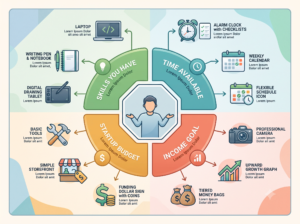
The right idea sits at the intersection of four things:
| Factor | Question to Ask |
|---|---|
| Skills | What can you already do that someone would pay for? |
| Time | How many hours per week can you realistically commit? |
| Budget | How much money can you spend to start? |
| Goal | Does this idea serve the goal you wrote down? |
Start with skills you already have. A graphic designer can freelance immediately; a teacher can tutor; a handy person can do repairs. Building on existing skills means you earn sooner and avoid spending weeks learning something from scratch.
If you are not sure what ideas are realistic, see our list of the 15 best side hustles for beginners — each is ranked by earning potential and ease of entry.
Step 3: Test the Idea Cheaply
The biggest mistake beginners make is spending money before validating that anyone will pay. Test first, invest second.
Start With What You Have
Use equipment you already own. Use free tools and platforms. Do not buy a premium website, expensive software, or inventory until you have earned at least a little money proving the idea works.
Get Your First Customer Manually
Your first customer does not come from an ad — they come from people you know or a direct outreach. Tell friends, family, and former colleagues what you are offering. Post it once on your personal network. Reach out to one potential client directly.
The goal of this stage is not scale. It is proof: one person paying you confirms the idea has demand.
Set a Minimum Price
Charge something from the start, even if it feels low. Free work attracts different expectations than paid work, and pricing tells you whether the value you provide is worth the time you spend.
Step 4: Build a Simple System
Once you have proof, build a lightweight system so the hustle does not become chaotic.
Track Your Income and Expenses
From your first dollar, record what you earn and what you spend on the hustle. This matters for taxes — side income is usually taxable, and good records make filing far easier. Read our guide on freelance taxes explained to understand what to track and what to set aside.
Set a Schedule
A side hustle lives or dies on consistency. Decide which days and hours you will work on it, and protect that time. Even three focused hours per week can produce results if they happen reliably.
Create a Simple Way for People to Pay and Contact You
You do not need a complex website at first. A single page, a profile on a freelance platform, or a clear social media presence is enough. Make it easy for someone to understand what you offer and how to pay you.
Keep It Separate From Personal Money
Open a separate account for hustle income and expenses, even if it is just a simple checking account. This makes tax time dramatically easier and shows you clearly whether the hustle is profitable.
Step 5: Find Your First Repeat Customers
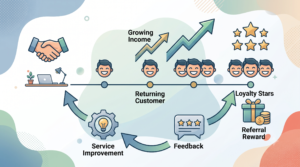
Your first customer is a breakthrough. Your first repeat customer is the foundation.
Repeat customers are valuable because they cost no additional marketing and they provide predictable income. To earn them:
- Deliver more than expected. A small surprise — early delivery, a bonus detail, a thank-you message — costs little and stands out.
- Ask for feedback. A quick check-in after the work is done shows professionalism and gives you a chance to fix anything quietly.
- Request a review or referral. Most satisfied customers will refer you if asked directly. Most will not offer unprompted.
- Stay in touch. A brief follow-up a month later keeps you in mind for the next need.
One repeat customer who hires you monthly can generate more income than ten one-time clients, and with far less effort to acquire.
Step 6: Manage the Money Properly
Extra income only helps if you manage it well. Without a plan, it blends into everyday spending and disappears.
Assign Every Dollar a Job
When side income arrives, decide immediately where it goes. Common allocations:
- A percentage to taxes (often 20–30% depending on your location and total income)
- A percentage to your goal (debt, savings, investing)
- A percentage back into the hustle (tools, ads, better equipment)
- A small percentage to spend freely, so the effort feels rewarding
Do Not Ignore Taxes
Side income is usually self-employment income, which means you may owe tax on it — and possibly quarterly estimated payments if the amount is significant. Set aside a portion of every payment so you are not surprised at tax time. Our guide on freelance taxes explained covers what to set aside and what you can deduct.
Direct the Net Income Somewhere Useful
Once taxes are covered, point the remaining money at your goal. If that goal is long-term wealth, read our guide on how to start investing with little money — even small monthly contributions can grow over time. If the goal is security, see why diversifying matters in our guide on how to diversify your income.
Step 7: Grow Without Burning Out
Growth is good, but a side hustle that burns you out will not last. Protect your energy and your main income.
Know When to Raise Prices
As your skills improve and demand increases, raise your rates. Many side hustlers stay underpriced for too long. If you are turning down work, your price is probably too low.
Say No to the Wrong Work
Not every client or job is worth taking. Work that pays poorly, drains your energy, or pulls you away from your main job can cost more than it earns.
Watch for Burnout Signals
If your side hustle is hurting your sleep, your performance at your day job, or your relationships, scale back. A sustainable three hours per week beats an unsustainable fifteen that collapses after two months.
Decide Whether to Scale or Stay Small
Some side hustles are meant to stay small — a steady extra stream that fits around life. Others are meant to grow into a full business. Both are valid. Read our guide on passive income myths vs reality to understand the difference between income that scales and income that simply trades more time for more money.
Real-World Example: From Zero to $600 Per Month
Consider a full-time office worker who wants to pay off a credit card balance faster.
Week 1 — Goal and idea: The goal is debt payoff. The worker is skilled at writing and editing, so they choose freelance editing as a side hustle. They commit to five hours per week.
Week 2 — First customer: They post once on a personal network and message two former colleagues. One refers a small business owner who needs blog posts edited. First job: $75 for editing three posts.
Week 3–4 — System: They open a separate account, track income, set aside 25% for taxes, and create a simple profile on a freelance platform to attract additional clients.
Month 2–3 — Repeat customers: The first client becomes a monthly retainer for $200. A second client from the platform adds $150 per month. A third small project adds $250.
By month 3: Roughly $600 per month in side income, with $150 set aside for taxes and $450 directed to the credit card balance — all on roughly five hours per week.
The point is not the exact numbers. It is the path: a clear goal, an existing skill, a cheap test, a simple system, and a few repeat customers.
Common Side Hustle Mistakes to Avoid
- Spending money before validating demand: Buy nothing significant until someone has paid you.
- Choosing an idea that does not match your skills: Learning a brand-new skill from scratch slows your first dollar by weeks or months.
- Underpricing for too long: If you have more demand than time, your price is too low.
- Ignoring taxes: Side income is usually taxable; set aside a portion from every payment.
- Mixing hustle money with personal money: Separate accounts make profitability and taxes far easier to track.
- Saying yes to every job: Poor clients cost you time and energy that could go to better work.
- Burning out by overcommitting: A sustainable schedule beats a short burst of intense effort.
- Having no goal for the income: Extra money without a purpose tends to get spent rather than saved.
- Quitting the day job too early: Most side hustles need months or years before they can replace a salary.
- Confusing side income with passive income: Most side hustles trade time for money; passive income is a different model entirely.
Frequently Asked Questions
How do I start a side hustle with no money?
Start with a service-based hustle that uses skills you already have. Use free tools and platforms, find your first customer through your personal network, and reinvest your early earnings into the hustle only after you have validated demand.
How much time does a side hustle take?
Most beginners start with three to ten hours per week. The amount you commit should fit around your main job and life without causing burnout. Consistency matters more than total hours.
Do I need to register a business to start a side hustle?
In many cases you can start as a sole proprietor without formal registration, though local rules vary. As your income grows, you may want to register formally for tax or liability reasons. Check the rules in your area.
How much should I charge for a side hustle?
Research what others charge for similar work in your market, then start at a rate that feels slightly uncomfortable but not so low that it attracts difficult clients. Raise prices as your skills and demand increase.
Do I have to pay taxes on side hustle income?
Yes, in most cases. Side income is usually self-employment income and may be taxable, plus you may owe self-employment tax depending on your location. Set aside a portion of every payment and read our freelance taxes explained guide for details.
Can a side hustle become a full-time business?
Yes, but it usually takes time. Most side hustles need months or years of growth before they can replace a salary. Test the idea, build consistent income, and only consider going full-time when the hustle can reliably cover your essential expenses.
What is the difference between a side hustle and passive income?
A side hustle typically requires your active time to earn — you trade hours for money. Passive income is income that continues with less ongoing effort after an initial investment of time or money. See our passive income myths vs reality guide for a full breakdown.
How do I keep side hustle income from disappearing?
Give every dollar a job the moment it arrives — taxes, your goal, reinvestment, and a small amount for spending. Pair this with our how to budget money guide so the extra income is directed intentionally rather than absorbed by lifestyle spending.
Key Takeaways
- A side hustle is income you control alongside your main paycheck, and it starts with a clear goal.
- The best idea sits at the intersection of your skills, your time, your budget, and your goal.
- Test cheaply before investing — your first customer should come from your network, not from paid ads.
- Build a simple system: track income, set a schedule, keep hustle money separate, and set aside money for taxes.
- Repeat customers are more valuable than one-time clients because they cost nothing to acquire and provide predictable income.
- Manage the money intentionally — assign every dollar to taxes, your goal, reinvestment, or spending.
- Grow carefully: raise prices when demand exceeds time, say no to bad work, and watch for burnout.
- A side hustle can stay small forever or grow into a full business — both are valid.
To go deeper, continue with our guides on the 15 best side hustles for beginners, freelance taxes explained, passive income myths vs reality, and how to diversify your income. To make sure the extra money works as hard as you do, read our guides on how to budget money and how to start investing with little money.
A side hustle is not a shortcut to wealth. It is a deliberate way to earn more, gain control, and direct extra income toward the goals that matter most — one focused hour at a time.
This article is for informational purposes only and is not financial, tax, or business advice. Income results vary based on effort, skills, market, and location. Consult a licensed professional for tax or legal questions specific to your situation.