

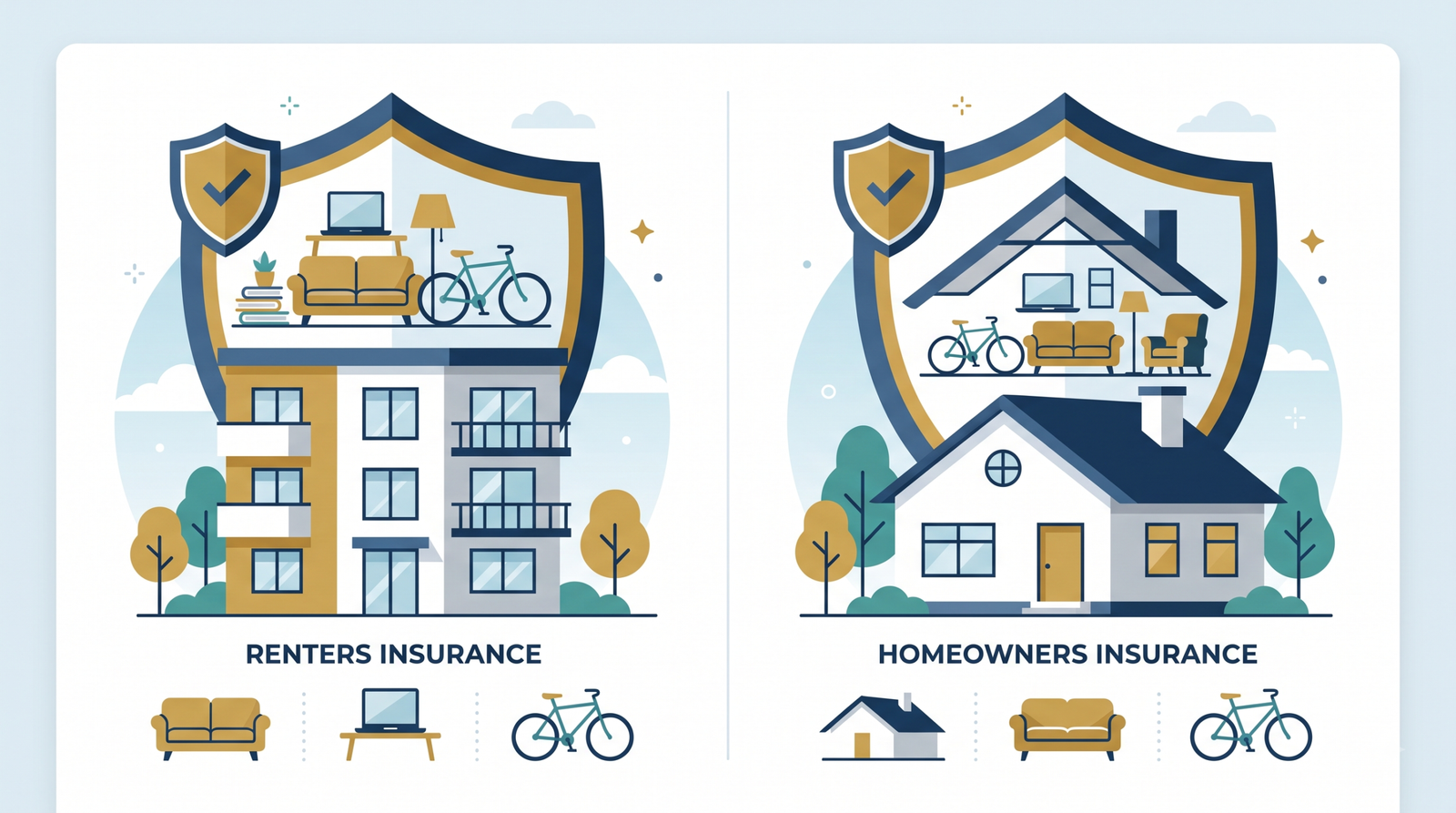

If you rent your home, there is a decent chance you do not have the insurance you should. If you own your home, there is a decent chance you do not fully understand what your policy covers — or does not.
Both renters and homeowners insurance protect the same broad categories of risk: your belongings, your liability, and the cost of living somewhere else if your home becomes unusable. But they differ in one fundamental way, and that difference explains why one policy is often skipped and the other is often misunderstood.
This guide answers the question do I need renters insurance, explains what does renters insurance cover, and provides a clear renters insurance vs homeowners insurance comparison so you know exactly which protection fits your living situation — and what each policy does not cover.
If you are still mapping out your overall protection plan, start with our pillar guide on the types of insurance you actually need at every life stage. This article focuses specifically on the property side.
What Renters Insurance Actually Covers
Many renters skip insurance because they assume their landlord’s policy covers their belongings. It usually does not. A landlord’s insurance typically covers the building itself — the structure, the plumbing, the roof — but not the things inside your unit that belong to you.
Renters insurance protects three main areas:
Personal Property
This covers your belongings — furniture, clothing, electronics, kitchen items, and other personal possessions — against covered events like fire, theft, vandalism, smoke, water damage from plumbing failures, and some weather events. If a break-in takes your laptop and your bike, this is the coverage that pays to replace them.
Liability
If someone is injured in your home — a guest slips, a pet bites, a leaking pipe damages the apartment below — liability coverage can pay for their medical costs or property repairs, and potentially legal costs if you are sued. This protection is often larger in value than the property coverage itself, and it is the part most renters do not realize they have.
Additional Living Expenses
If a covered event makes your home unlivable — a fire, for example — this pays for temporary housing, meals, and other extra costs while your home is being repaired. Without it, you would bear those costs yourself.
So to answer the question directly: what does renters insurance cover? It covers your stuff, your legal responsibility to others, and your cost of living elsewhere after a covered loss. What it does not cover is the building itself — that remains the landlord’s responsibility.
What Homeowners Insurance Actually Covers
Homeowners insurance covers everything renters insurance covers, plus the structure of the home itself. A standard policy typically includes:
Dwelling Coverage
This pays to repair or rebuild the physical structure of your home — the walls, roof, floors, built-in fixtures, and attached structures like a garage — if damaged by a covered event. This is the largest part of a homeowners policy and the part most often underinsured, because people insure for the home’s market value rather than its rebuild cost.
Other Structures
This covers structures not attached to the home — a detached garage, fence, shed, or gazebo.
Personal Property
Same as renters insurance: your belongings, covered against the same types of events.
Liability
Same as renters insurance: protection if someone is injured on your property or you cause damage to someone else’s property.
Additional Living Expenses
Same as renters insurance: temporary housing and extra costs if your home becomes unlivable.
The key distinction is the dwelling coverage. Renters insurance does not include it because the renter does not own the building. Homeowners insurance does because the owner bears the rebuild cost.
Renters Insurance vs Homeowners Insurance: Side-by-Side
| Feature | Renters Insurance | Homeowners Insurance |
|---|---|---|
| Building/structure coverage | No — landlord’s responsibility | Yes — dwelling coverage included |
| Personal property coverage | Yes | Yes |
| Liability coverage | Yes | Yes |
| Additional living expenses | Yes | Yes |
| Other structures (shed, fence) | No | Yes |
| Typical monthly cost | Low | Much higher |
| Required by | Sometimes by landlords | Usually by mortgage lenders |
| Best for | Tenants who rent their home | Owners who hold the property |
The cost difference is significant because the risk is different. A homeowner’s insurer may have to pay hundreds of thousands of dollars to rebuild a destroyed house. A renter’s insurer is only covering belongings and liability, so the premium is usually a fraction of the cost.
Do I Need Renters Insurance? How to Decide
The short answer for most renters is yes — and the reasons are rarely what people expect.
Your Belongings Are Worth More Than You Think
Try mentally walking through your home and adding up what it would cost to replace everything — furniture, clothing, electronics, kitchen items, shoes, books. Most people underestimate this by a wide margin. A renters policy typically covers all of it for a low monthly cost.
Liability Risk Is Real Even in a Rental
If a guest is injured in your apartment, or your bathtub overflows into the unit below, you — not your landlord — can be held responsible. Liability coverage protects you against costs that could exceed the value of your belongings many times over.
The Cost Is Usually Surprisingly Low
Renters insurance is one of the most affordable policies available. Many tenants pay less per month than they spend on a single streaming subscription. For that cost, you get property and liability protection that would otherwise come entirely out of pocket.
Your Landlord May Require It
An increasing number of landlords and property management companies require renters insurance as a condition of the lease. Even when it is not required, it is usually worth it.
When You Might Not Need It
The rare exception is if your belongings are worth very little and you have enough savings to replace them and to cover a potential liability claim. For most renters, that is not the case.
Do I Need Homeowners Insurance? How to Decide
If you own a home with a mortgage, the answer is almost always yes — and your lender likely requires it. If you own your home outright, the decision is yours, but the risk is the same.
Your Home Is Likely Your Largest Asset
For most people, a home is the most valuable thing they own. An uninsured fire, major storm, or other covered event could destroy that asset and leave you with nothing but the land. Homeowners insurance protects the investment.
Rebuild Costs Are Large and Often Unexpected
Even a partial loss — a kitchen fire, a burst pipe that damages floors — can cost tens of thousands to repair. Most households cannot absorb that cost without insurance.
Liability Exposure Is Higher for Owners
Homeowners generally have more liability exposure than renters: larger properties, more structures, more risk of someone being injured on the premises. Liability coverage protects against claims that could exceed your net worth.
Insure for Rebuild Cost, Not Market Value
A common and costly mistake is insuring the home for its market value rather than what it would cost to rebuild. In some markets, rebuild cost is higher than market value; in others, it is lower. Check the rebuild cost specifically, not the home’s sale price.
How to Choose the Right Coverage Level
Whether you rent or own, a few principles help you pick the right amount of coverage:
Make a Home Inventory
Walk through your home and list your belongings with estimated replacement values. This tells you how much personal property coverage you actually need. Keep receipts or photos for valuable items — it makes a claim far smoother.
Understand Actual Cash Value vs Replacement Cost
Actual cash value pays what your belongings are worth after depreciation — an older laptop may pay very little. Replacement cost pays what it costs to buy a new equivalent item. Replacement cost coverage costs slightly more but is usually worth it.
Choose a Deductible You Can Afford
A higher deductible lowers your premium but increases your out-of-pocket cost in a claim. Pair the deductible with your cash buffer — read our emergency fund guide to make sure you could cover it.
Check the Liability Limit
Liability limits are often too low. Consider whether your coverage would protect your assets if you were sued. An umbrella policy, discussed in our types of insurance guide, can extend that protection.
Bundle for a Discount
Many insurers offer a discount when you combine property insurance with auto coverage. See our guide on how car insurance rates are calculated to understand the auto side of a potential bundle.
Real-World Example: Two Households, Different Needs
Consider two households in similar neighborhoods.
Household A — Renter, age 27, apartment:
- Belongings: roughly $20,000 in furniture, electronics, clothing, and kitchen items
- Chose: renters insurance with $20,000 property coverage, $100,000 liability, $500 deductible, replacement cost
- Monthly cost: roughly $15
- Why: For a low monthly cost, the renter protects belongings and liability that would otherwise come entirely out of pocket
Household B — Homeowner, age 34, purchased a home:
- Home rebuild cost: $300,000
- Belongings: roughly $35,000
- Chose: homeowners insurance with $300,000 dwelling, $35,000 property, $300,000 liability, $1,000 deductible
- Monthly cost: roughly $100 (often paid into an escrow account with the mortgage)
- Why: The lender requires dwelling coverage, and the rebuild cost is far beyond what the household could absorb without insurance
The renter pays far less because the insurer is not covering the building. But both households are protected against the same personal property and liability risks — and both would face serious costs without coverage.
Common Renters and Homeowners Insurance Mistakes to Avoid
- Assuming a landlord’s policy covers a renter’s belongings: It usually does not. A landlord insures the building, not your things.
- Insuring a home for market value instead of rebuild cost: These numbers can differ significantly; match coverage to rebuild cost.
- Choosing actual cash value over replacement cost: Depreciation can leave you far short of what you need to replace an item.
- Setting liability limits too low: Liability claims can exceed property value; review your net worth when choosing a limit.
- Skipping an inventory: Without a list, a claim becomes a guessing game and you may underclaim.
- Forgetting to update coverage after major purchases: New furniture, renovations, or valuables may require a coverage review.
- Ignoring what is excluded: Floods, earthquakes, and some other events are often not covered by standard policies and may need separate coverage.
- Choosing a deductible you cannot afford: A high deductible saves on premium but creates a cash crisis if you cannot pay it.
- Not bundling when it would save money: Combining home and auto often lowers both premiums.
- Filing small claims unnecessarily: Small claims can raise your premium for years; paying a minor repair out of pocket may be cheaper long-term.
Frequently Asked Questions
Do I need renters insurance?
For most renters, yes. It protects your belongings, covers your liability if someone is injured in your home, and pays for temporary housing if your home becomes unlivable — usually for a low monthly cost.
What does renters insurance cover?
Renters insurance covers your personal property against events like fire, theft, vandalism, and some water damage; your liability if someone is injured or you damage another person’s property; and additional living expenses if you cannot live in your home after a covered loss.
What is the difference between renters and homeowners insurance?
Homeowners insurance includes everything renters insurance covers, plus dwelling coverage for the physical structure of the home. Renters insurance does not cover the building because the renter does not own it. This is why renters insurance costs much less.
Is renters insurance worth it if I do not own much?
Often, yes. Even if your belongings are modest, the liability coverage alone can be worth the low premium. If a guest is injured or you damage a neighboring unit, the cost could far exceed the value of your possessions.
How much does renters insurance cost?
Renters insurance is typically one of the most affordable policies available. Many renters pay less per month than the cost of a single streaming subscription, though the exact price depends on location, coverage amount, and deductible.
Does homeowners insurance cover everything in my home?
It covers belongings against many events, but not all. Flooding, earthquakes, and certain other events are often excluded and may require separate policies. Always read the exclusions before assuming you are covered.
Should I insure my home for what I paid for it?
Not necessarily. You should insure for the rebuild cost — what it would cost to rebuild the home from scratch. This can be higher or lower than the purchase price depending on labor costs, materials, and local conditions.
Can I bundle renters or homeowners insurance with my car insurance?
Yes, and it often saves money. Many insurers offer a discount when you combine property and auto coverage. See our guide on how car insurance rates are calculated to understand the auto side of a bundle.
Key Takeaways
- Renters insurance and homeowners insurance both cover personal property, liability, and additional living expenses.
- Homeowners insurance adds dwelling coverage for the structure — the main reason it costs more.
- A landlord’s policy covers the building, not a renter’s belongings — that is why renters need their own policy.
- Renters insurance is usually very affordable and often underused.
- Homeowners should insure for rebuild cost, not market value, to avoid being underinsured.
- Choose replacement cost over actual cash value so you can actually replace your belongings.
- Pair your deductible with a cash buffer so a claim does not create a separate financial crisis.
- Review liability limits against your net worth, and consider an umbrella policy as assets grow.
- Bundle property and auto insurance when it produces a real discount.
To understand where property insurance fits in your full protection plan, read our pillar guide on the types of insurance you actually need at every life stage. For the auto side of a home-and-auto bundle, see how car insurance rates are calculated, and for the cash buffer behind your deductible, read our emergency fund guide.
The right property insurance is not about buying the most coverage — it is about making sure a fire, theft, or liability claim does not become a financial disaster, at a price you can sustain.
This article is for informational purposes only and is not financial or insurance advice. Coverage needs, costs, and exclusions vary by individual, location, and provider. Review specific policy terms with a licensed professional before purchasing.