

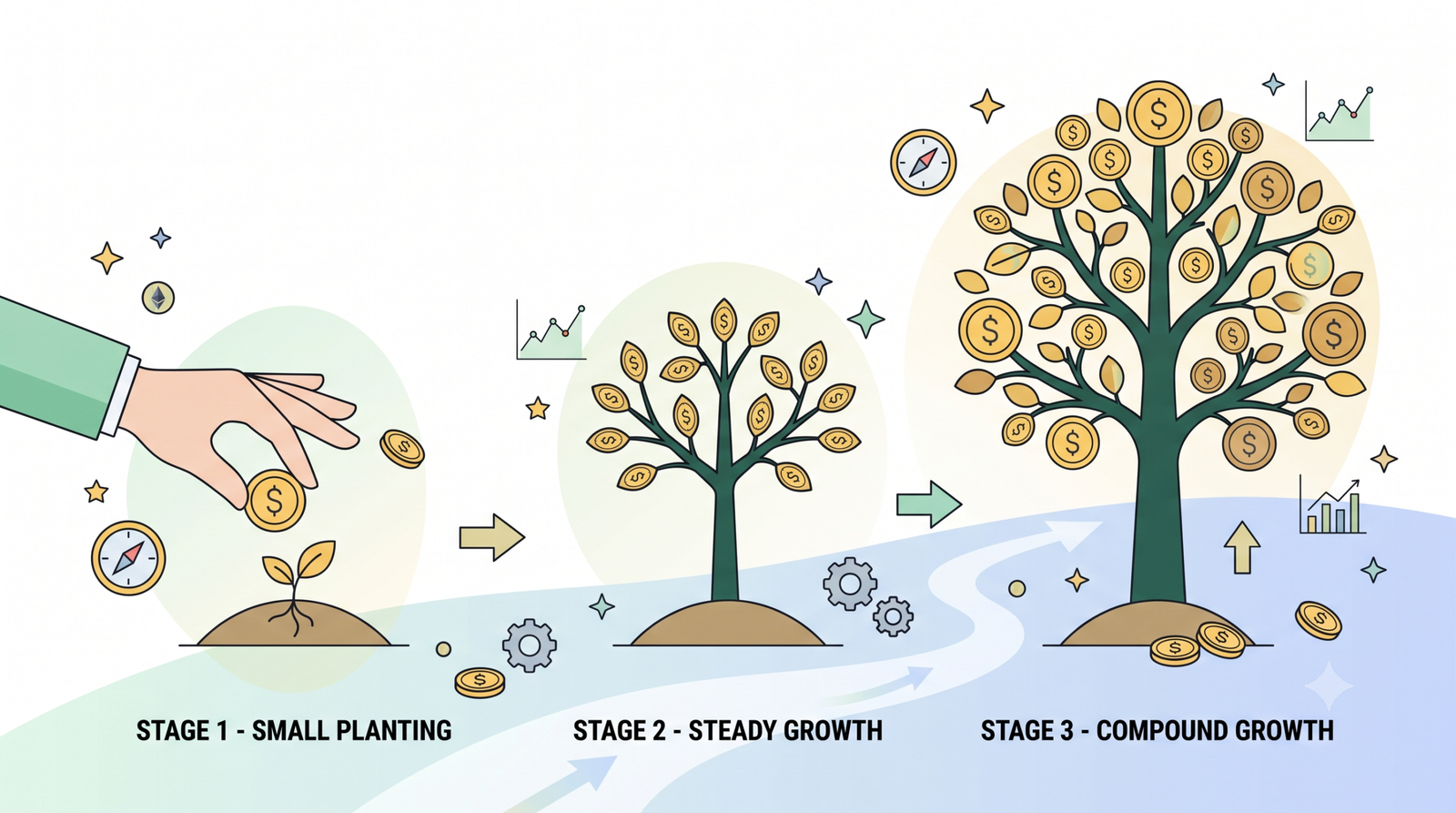

If there’s one concept that separates people who build significant wealth over time from those who don’t, it isn’t income, luck, or picking the “right” stock. It’s understanding — and actually acting on — how compound interest works. Yet it’s one of the most underestimated concepts in personal finance, mostly because its real power only becomes visible over long stretches of time that are hard to picture in advance.
This guide breaks down exactly what compound interest is, why time matters more than the amount you invest, and shows real side-by-side numbers comparing someone who starts early versus someone who starts later but invests more. If you haven’t started investing yet, our complete guide on how to start investing with little money covers the practical first steps — this article explains the underlying math that makes starting early so valuable.
What Compound Interest Actually Means
Compound interest is the process of earning returns not just on your original investment, but also on the returns that investment has already generated. In simple terms: your money starts making money, and then that new money starts making money too.
This is fundamentally different from simple interest, where you only ever earn a return on your original amount. The distinction seems small in year one, but the gap widens dramatically over longer time periods, because each year’s growth becomes part of the base that grows again the following year.
A Simple Example to Build Intuition

Imagine investing $1,000 at a 7% annual return:
- Year 1: $1,000 grows to $1,070 (a $70 gain)
- Year 2: $1,070 grows to $1,144.90 (a $74.90 gain — more than year one, because you’re now earning 7% on $1,070, not just the original $1,000)
- Year 10: The original $1,000 has grown to approximately $1,967
Notice the gain in year two was already larger than year one, without adding any new money. That accelerating pattern is the entire mechanism behind compound interest — and it becomes dramatically more visible the longer money is left to grow.
The Three Variables That Determine Compound Growth
Compound growth is driven by three factors, and understanding which one you have the most control over changes how you should think about investing:
- Principal — the amount you start with or contribute regularly
- Rate of return — the average annual growth rate, which varies by investment type and isn’t something you can control or guarantee
- Time — how long the money stays invested before you need it
Of these three, time is the variable most people underestimate, and it’s also the one where small differences produce the largest outcomes — which is exactly what the next section demonstrates with real numbers.
Real Numbers: Starting Early vs. Investing More Later

Here’s the comparison referenced in the title of this guide — two people, two very different starting points, both investing until age 65, assuming a 7% average annual return (a commonly cited long-term historical average for diversified stock investments; actual returns vary and are never guaranteed):
Investor A: Starts at 25, invests $100/month, stops contributing at 35 (10 years of contributions), then leaves the money invested untouched until 65
- Total contributed: $12,000
- Approximate value at 65: ~$135,000
Investor B: Starts at 35, invests $300/month every year until 65 (30 years of contributions)
- Total contributed: $108,000
- Approximate value at 65: ~$113,000
These figures are illustrative estimates based on an assumed 7% average annual return and are not a guarantee of future performance — actual investment returns vary and can include losses.
Investor A contributed nine times less money in total ($12,000 vs. $108,000) but ended up with a larger balance. This is the central, counterintuitive lesson of compound interest: the ten years Investor A had that Investor B didn’t — between ages 25 and 35 — turned out to be more valuable than an additional $96,000 of contributions later on.
Why the Early Years Matter So Disproportionately
The reason this happens comes back to the accelerating pattern shown in the simple $1,000 example earlier. Money invested earlier has more compounding cycles working on it. A dollar invested at 25 has 40 years to compound before retirement at 65; that same dollar invested at 35 only has 30 years — and because each year’s growth builds on the previous year’s larger total, that missing decade at the beginning is worth far more than an equivalent decade added at the end.
This is also why financial guidance consistently emphasizes starting something, even small, as early as possible, rather than waiting until you can invest a larger amount. The cost of waiting isn’t just the missed contributions — it’s the lost compounding time on every dollar that would have been invested during that period.
How Fees Work Against You the Same Way Growth Works for You
Compound interest doesn’t only apply to investment growth — it applies to costs as well. An investment fee of even 1% per year might sound small, but because it’s deducted annually from a growing balance, it compounds against you the same way returns compound for you. Over several decades, this can meaningfully reduce your final balance, which is one of the reasons low-cost, diversified investments are so often recommended for long-term investors — a topic covered in detail in Stocks vs ETFs vs Mutual Funds: What Beginners Should Actually Buy.
The same logic applies to high-interest debt, in reverse: compound interest working against you on a credit card balance grows just as fast as it would grow for you in an investment account — which is a major reason high-interest debt is generally prioritized before aggressive investing.
How to Put Compound Interest to Work in Your Own Plan
- Start now, even with a small amount. As shown above, the time value of starting early consistently outweighs waiting to invest a larger sum later.
- Contribute consistently rather than sporadically. Regular contributions, even automated small ones, take fuller advantage of compounding than occasional larger deposits.
- Choose accounts and investments with low fees. Since fees compound against your balance the same way growth compounds in your favor, minimizing unnecessary costs meaningfully affects your long-term outcome.
- Use tax-advantaged accounts where possible. Retirement accounts like a Roth or Traditional IRA allow investments to compound with certain tax advantages, which can further improve long-term outcomes — see the full comparison in Roth IRA vs Traditional IRA: Which Retirement Account Is Right for You?
- Avoid interrupting the compounding process. Withdrawing invested funds early, even temporarily, resets part of the compounding timeline and can meaningfully reduce long-term growth.
A Common Misunderstanding: “I’ll Catch Up Later”
One of the most common and costly assumptions beginners make is that they can simply invest more aggressively later to make up for a delayed start. As the Investor A vs. Investor B comparison shows, this often requires a dramatically larger contribution to produce a similar or smaller outcome — nine times the total contribution, in that specific example, just to fall slightly short. This doesn’t mean it’s ever too late to start investing; it means that the earliest years available to you carry outsized value, and delaying reduces — but doesn’t eliminate — the benefit of starting.
Frequently Asked Questions
What is a good example of compound interest in everyday terms?
A savings or investment account where your annual returns are added to your balance, and then next year’s returns are calculated on that new, larger balance, is a straightforward everyday example — this is different from simple interest, which only ever calculates returns on the original amount.
How much difference does starting 10 years earlier actually make?
As shown in the real-numbers comparison above, starting 10 years earlier with far smaller total contributions ($12,000) resulted in a larger balance than starting later with nearly nine times more total contributions ($108,000), assuming the same average rate of return.
Does compound interest apply to debt as well as investments?
Yes. Compound interest works the same way on debt, particularly credit cards, meaning unpaid interest can be added to your balance and then itself accrue interest — which is why high-interest debt tends to grow quickly if left unpaid.
Is a 7% annual return realistic for compound interest examples?
7% is a commonly cited long-term historical average for diversified stock market investments, often used for illustrative purposes. Actual annual returns vary significantly year to year and are never guaranteed — some years may show losses.
Is it too late to benefit from compound interest if I’m starting in my 30s or 40s?
No — compound interest still works at any starting age, and time remaining until you need the money still matters significantly. Starting later simply means the earliest, most valuable compounding years have already passed, making consistent contributions from today forward even more important.
Key Takeaways
- Compound interest means your returns generate their own returns over time, creating an accelerating growth pattern rather than a flat one.
- Time is often more powerful than the amount invested — starting 10 years earlier can outperform investing significantly more money later.
- Fees compound against your balance the same way growth compounds in your favor, making low-cost investment choices meaningfully important over decades.
- Consistent, automated contributions take fuller advantage of compounding than occasional larger deposits.
- The best time to start investing is as early as possible, even with a small amount — see how to start investing with little money for the practical first steps.
This article is for informational and educational purposes only and is not personalized financial advice. All investing carries risk, including potential loss of principal, and past performance does not guarantee future results. Consider speaking with a licensed financial professional for guidance specific to your situation.