



Stocks vs ETFs vs Mutual Funds: What Beginners Should Actually Buy
Once you’ve decided to start investing, the next question is usually the one that stalls people for weeks: what do I actually buy? Open any investing app and you’ll see thousands of options — individual stocks, ETFs, mutual funds — with no obvious starting point for someone who’s never done this before.
This guide breaks down exactly what each option is, how they differ in risk, cost, and complexity, and which one most beginners should actually start with. If you haven’t yet worked through the basics of getting started, our complete guide on how to start investing with little money covers account setup and contribution amounts — this article picks up from there and focuses specifically on what to put in that account.
The Core Difference in One Sentence Each
- A stock is a small ownership stake in a single company.
- An ETF (exchange-traded fund) is a basket of many stocks (or bonds) bundled together and traded like a single stock.
- A mutual fund is also a basket of many investments, but bought and sold once per day at a set price, usually through a fund company rather than traded throughout the day.
The rest of this guide unpacks what that actually means for risk, cost, and how simple each option is for a beginner to manage.
Stocks: Owning a Piece of One Company

When you buy a share of stock, you’re buying a tiny ownership stake in that specific company. If the company grows and becomes more valuable, your share generally becomes worth more. If it struggles, your investment can lose significant value — even fall to zero in extreme cases.
Pros:
- Full control over exactly which companies you own
- No ongoing management fees
- Potential for significant growth if you pick a company that performs well
Cons:
- Concentration risk — your investment depends entirely on one company’s performance
- Requires research and ongoing attention to make informed decisions
- Emotionally harder to hold through volatility, since news about a single company can swing the price dramatically
Best for: Investors who want to research specific companies and are comfortable with higher risk in exchange for potentially higher reward — generally recommended as a smaller portion of a portfolio, not the entire starting point for beginners.
ETFs: A Basket of Investments, Traded Like a Stock
An ETF holds a collection of stocks, bonds, or other assets — sometimes tracking an entire market index (like the S&P 500), sometimes a specific sector (like technology or healthcare). When you buy one share of an ETF, you’re instantly getting exposure to everything inside that basket.
Pros:
- Instant diversification — one purchase spreads your money across dozens or hundreds of companies
- Typically low ongoing fees, especially for index-tracking ETFs
- Trades throughout the day like a stock, offering flexibility
- Many platforms allow fractional shares, making ETFs accessible with very small amounts
Cons:
- You won’t beat the market if you’re tracking a broad index — you’ll simply match its average performance
- Price can fluctuate throughout the trading day, which can tempt beginners into short-term reactive decisions
Best for: Most beginners. The combination of built-in diversification, low cost, and simplicity makes broad-market ETFs one of the most commonly recommended starting points for new investors.
Mutual Funds: A Basket Managed Once a Day
Mutual funds are similar to ETFs in that they also pool money into a diversified basket of investments. The key structural difference is timing and management style:
- Mutual funds are priced and traded once per day, after markets close, rather than continuously throughout the day like ETFs.
- Many (though not all) mutual funds are actively managed, meaning a professional fund manager makes ongoing decisions about what to buy and sell, aiming to outperform the market — for a higher fee than most ETFs.
- Some mutual funds are passively managed index funds, which simply track a market index at a low cost, functioning similarly to an index ETF.
Pros:
- Diversification similar to ETFs
- Actively managed options offer professional decision-making, for investors who prefer that
- Common default option inside many employer-sponsored retirement plans
Cons:
- Actively managed mutual funds typically carry higher fees than ETFs, and historically, the majority of actively managed funds underperform their benchmark index over long periods, after fees
- Some mutual funds have minimum investment requirements
- Only tradable once per day, offering less flexibility than ETFs
Best for: Investors using an employer-sponsored retirement account where mutual funds are the primary or only option available, or those who specifically prefer professionally managed funds despite the higher cost.
Side-by-Side Comparison
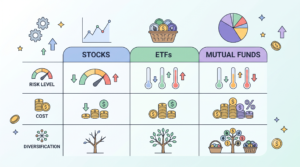
| Feature | Stocks | ETFs | Mutual Funds |
|---|---|---|---|
| Diversification | Low (single company) | High (basket of many) | High (basket of many) |
| Typical Cost | No management fee | Usually low | Often higher, especially if actively managed |
| Trading Flexibility | Throughout the day | Throughout the day | Once per day, after market close |
| Minimum Investment | Price of 1 share (or fractional) | Price of 1 share (or fractional) | Sometimes a set minimum (e.g., $500–$3,000) |
| Best Suited For | Experienced or research-focused investors | Most beginners | Employer retirement plans, hands-off investors |
What Is an Index Fund, and Why Does It Come Up So Often?
An index fund isn’t a separate category from ETFs and mutual funds — it’s a strategy that either can use. An index fund simply aims to match the performance of a specific market index (like the S&P 500) rather than trying to beat it through active stock-picking.
Index funds are frequently recommended for beginners because of three consistent advantages:
- Lower fees, since there’s no active manager making frequent trading decisions
- Broad diversification, since a single index fund can include hundreds of companies
- Historically strong long-term performance relative to many actively managed alternatives, particularly after accounting for fees, though past performance never guarantees future results
Both ETFs and mutual funds can be structured as index funds — the underlying strategy is the same; only the trading mechanics differ.
Real-World Example: $100 Invested Three Different Ways
To make the difference concrete, imagine investing the same $100 in three different ways:
- Option A — Single stock: $100 buys shares in one company. If that company grows 20% in a year, the investment grows to $120. If it drops 20%, it falls to $80. The entire outcome depends on one company.
- Option B — Broad-market index ETF: $100 buys a small slice of hundreds of companies across the market. A market downturn affecting a few companies has a much smaller impact, since it’s diluted across the full basket.
- Option C — Actively managed mutual fund: $100 buys the same broad diversification as the ETF, but a portion of returns is reduced over time by higher management fees, and performance depends on the fund manager’s decisions relative to the market.
This is why broad-market ETFs are so often the default beginner recommendation: they combine the diversification benefit of Option C without the added fee drag, while avoiding the concentration risk of Option A.
Common Mistakes Beginners Make
- Starting with individual stocks based on hype rather than research. A stock trending on social media isn’t the same as a sound long-term investment.
- Confusing “diversified” with “safe.” ETFs and mutual funds reduce company-specific risk, but the overall market can still decline — diversification manages risk, it doesn’t eliminate it.
- Ignoring fees, especially in actively managed mutual funds. A seemingly small 1% annual fee difference compounds into a substantial amount over decades — this connects directly to the mechanics explained in Compound Interest Explained: Why Starting Early Beats Investing More, since fees compound against you the same way growth compounds for you.
- Trying to time individual stock picks instead of investing consistently. Beginners frequently overestimate their ability to predict which individual companies will outperform the broad market.
So What Should a Complete Beginner Actually Buy First?
For most people just starting out, a low-cost, broad-market index ETF is the most commonly recommended first investment — it offers instant diversification across hundreds of companies, typically low fees, and the flexibility to buy in small, fractional amounts. Individual stocks and actively managed mutual funds both have valid roles for specific goals, but they generally work best as a smaller, deliberate addition to a portfolio rather than the entire starting point.
Frequently Asked Questions
Are ETFs safer than individual stocks?
ETFs are generally considered lower-risk than individual stocks because they spread your money across many companies instead of one, reducing the impact of any single company’s poor performance. However, ETFs still carry market risk and can decline in value.
What’s the difference between an ETF and an index fund?
An index fund is a strategy (tracking a market index), while an ETF is a trading structure (traded throughout the day like a stock). An ETF can be an index fund, and a mutual fund can also be an index fund — the terms describe different things and aren’t mutually exclusive.
Do mutual funds always have higher fees than ETFs?
Not always — passively managed index mutual funds can have fees comparable to ETFs. However, actively managed mutual funds, which involve ongoing decision-making by a fund manager, typically carry higher fees than most ETFs.
Can beginners buy stocks, ETFs, and mutual funds with a small amount of money?
Yes, in most cases. Fractional shares have made stocks and ETFs accessible with very small amounts, though some mutual funds still require a minimum initial investment, often ranging from $500 to $3,000.
Should I only invest in one type — stocks, ETFs, or mutual funds?
Many beginners start with a single low-cost, diversified ETF or index fund and expand from there as they become more comfortable, rather than trying to build a complex mix of all three types immediately.
Key Takeaways
- Stocks represent ownership in a single company; ETFs and mutual funds bundle many investments into one diversified basket.
- ETFs trade throughout the day like a stock; mutual funds trade once per day and are more often actively managed, which can mean higher fees.
- Index funds (which can be either ETFs or mutual funds) track a market index and are widely recommended for beginners due to low fees and broad diversification.
- A low-cost, broad-market index ETF is one of the most commonly recommended starting points for new investors.
- Fees matter more than they seem — even a 1% difference compounds significantly over time, as explained in Compound Interest Explained.
This article is for informational and educational purposes only and is not personalized financial advice. All investing carries risk, including potential loss of principal. Consider speaking with a licensed financial professional for guidance specific to your situation.