


How to Start Investing With Little Money: A Beginner’s Guide
One of the most common reasons people delay investing isn’t lack of interest — it’s the belief that investing requires thousands of dollars, a finance background, or a broker in a suit. None of that is true anymore. In 2026, you can start investing with as little as $5–$50, from an app on your phone, without any prior experience.
This guide walks through exactly how to start investing on a limited budget — how much you actually need, where to open an account, what to buy first, and the mistakes that trip up almost every beginner in their first year. By the end, you’ll have a clear, realistic first step you can take this week, even if all you have to invest is $25.
Do You Really Need to Budget Before You Invest?
Before diving into investing mechanics, it’s worth being honest about sequencing: investing works best once your basic finances are stable. That doesn’t mean waiting until you’re debt-free or have thousands saved — it means having a working budget and at least a small buffer for emergencies, so a surprise expense doesn’t force you to sell your investments at a bad time.
If you haven’t built a budget yet, our complete guide on how to budget money is a useful first step — even a basic system that frees up $25–50 a month is enough to start the strategies below.
How Much Money Do You Actually Need to Start Investing?
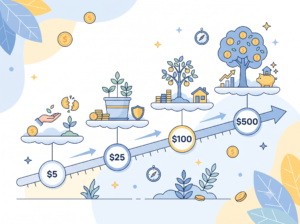
The honest answer: there is no minimum you need to “qualify” as an investor. Thanks to fractional shares — the ability to buy a small slice of an expensive stock or fund instead of a whole share — many platforms let you start investing with as little as $1–$5.
That said, here’s a realistic framework for how much matters at different stages:
| Amount | What It’s Realistic For |
|---|---|
| $5–$25 | Testing the process, buying your first fractional shares, building the habit |
| $50–$100/month | A meaningful, consistent investing habit that compounds significantly over time |
| $500+ | Enough to consider account minimums for certain retirement accounts or diversified portfolios |
The amount matters far less than starting consistently and early — a concept covered in depth in our guide on compound interest and why starting early beats investing more.
Step-by-Step: How to Start Investing With a Small Amount
Step 1: Build a Small Buffer First
Before investing, aim to have at least a small cash cushion (even $500–1,000) set aside separately, so you’re not forced to sell investments during a market downturn to cover an emergency. Investments need time to grow — pulling money out early, especially during a dip, is one of the most common ways beginners lose money unnecessarily.
Step 2: Choose the Right Type of Account
This is the most consequential early decision, because it affects your taxes for decades:
- Employer-sponsored retirement account (if available): Often the best starting point, especially if your employer matches contributions — that match is essentially free money.
- Individual Retirement Account (IRA): A strong option if you don’t have access to an employer plan, or want additional tax-advantaged investing beyond it. The choice between account types is covered fully in Roth IRA vs Traditional IRA: Which Retirement Account Is Right for You?
- Standard brokerage account: No contribution limits or tax advantages, but full flexibility — useful for goals outside retirement, or once tax-advantaged accounts are being used.
Step 3: Pick an Investment Platform With Low or No Minimums
Look for platforms that specifically support fractional shares and have no or very low account minimums — this is standard among most major investing apps in 2026, but it’s worth confirming before opening an account, since fees and available investment types vary.
Step 4: Decide What to Actually Buy

For most beginners investing small, consistent amounts, a low-cost, diversified fund (rather than individual stocks) is the most common recommended starting point, because it spreads risk across many companies instead of concentrating it in one. The specific differences between stocks, ETFs, and mutual funds — and which tends to suit beginners best — are covered in full detail in Stocks vs ETFs vs Mutual Funds: What Beginners Should Actually Buy.
Step 5: Automate Your Contributions
Set up an automatic transfer of a fixed amount into your investment account on payday — even $25–50. Automating removes the decision fatigue and emotional timing mistakes (like trying to “wait for a dip”) that derail many beginner investors.
Step 6: Leave It Alone
The single hardest — and most valuable — skill in investing is doing nothing during market volatility. Checking your account daily and reacting to short-term swings is one of the most common ways beginners undermine their own long-term returns.
Real-World Example: Investing $50 a Month Starting at Age 25
To make the impact of starting small but early concrete, consider someone who invests $50 a month starting at age 25, earning an average annual return of 7% (a commonly cited long-term historical average for diversified stock market investments, though actual returns vary and are never guaranteed):
| Age | Total Contributed | Approximate Value (7% avg. return) |
|---|---|---|
| 35 (10 years in) | $6,000 | ~$8,700 |
| 45 (20 years in) | $12,000 | ~$25,900 |
| 55 (30 years in) | $18,000 | ~$59,600 |
| 65 (40 years in) | $24,000 | ~$128,900 |
These figures are illustrative estimates based on an assumed average return and are not a guarantee of future performance — actual investment returns vary and can include losses.
Notice that the total contributed over 40 years is only $24,000, while the estimated ending value is over five times that amount. This is the core mechanism explained fully in Compound Interest Explained: Why Starting Early Beats Investing More — and it’s the single strongest argument for starting with a small amount now rather than waiting until you can invest “more.”
Common Mistakes Beginners Make When Starting Small
- Waiting until they have “enough” to start. Because of fractional shares, there’s no real minimum left to wait for — waiting mainly costs you time, which is the one resource compound growth depends on most.
- Picking individual stocks based on hype instead of starting with diversified funds. This is covered in more detail in Common Investing Mistakes Beginners Make (And How to Avoid Them).
- Investing money they might need in the next 1–3 years. Short-term goals belong in savings, not investments, since markets can decline temporarily and unpredictably.
- Checking the account too frequently and reacting emotionally to normal short-term fluctuations.
- Not taking a full employer match if one is available. Skipping a matched contribution is effectively turning down free money before even considering other investment options.
How Long Before You See Real Progress?
Investing small amounts can feel discouragingly slow in the first year or two — a few hundred dollars invested doesn’t create a dramatic account balance right away, and that’s normal. The meaningful growth in the example above happens in later decades, not the first few years. The goal early on isn’t a big balance; it’s building the consistent habit and the account infrastructure that compound growth needs time to work on.
Frequently Asked Questions
Can I really start investing with only $50?
Yes. Thanks to fractional shares, most major investment platforms allow you to start with very small amounts — what matters most is starting consistently, not the size of your first contribution.
Should I pay off debt before I start investing?
This depends on the interest rate of your debt. High-interest debt (like most credit card debt) usually costs more than typical investment returns, so many financial guides suggest prioritizing that debt first, while still contributing enough to capture any employer retirement match. See our guide on how to get out of debt for a full payoff strategy.
What should a complete beginner invest in first?
A low-cost, diversified fund (such as a broad-market ETF) is a common starting point for beginners, since it spreads risk across many companies rather than concentrating it in a single stock. Full comparison in Stocks vs ETFs vs Mutual Funds.
Is investing risky if I only have a small amount of money?
All investing carries risk, including the possibility of loss, regardless of the amount invested. However, investing small, consistent amounts over a long time horizon has historically helped smooth out short-term volatility compared to investing a large lump sum at a single point in time.
How often should I check my investment account?
For long-term investing, checking monthly or quarterly is generally more than enough. Frequent checking tends to encourage emotional reactions to normal short-term market movement, which can lead to costly, avoidable mistakes.
Key Takeaways
- You don’t need a large sum to start investing — fractional shares make it possible to begin with as little as $5–$50.
- Build a small emergency buffer first, so you’re never forced to sell investments to cover an unexpected cost.
- Choose the right account type (employer plan, IRA, or brokerage) before choosing what to invest in — see Roth IRA vs Traditional IRA for the tax-advantaged options.
- Starting early matters more than starting big, thanks to compound growth — see the full explanation in Compound Interest Explained.
- Automate contributions and avoid checking your account too frequently — most beginner mistakes come from emotional, short-term reactions rather than the investments themselves.
This article is for informational and educational purposes only and is not personalized financial advice. All investing carries risk, including potential loss of principal. Consider speaking with a licensed financial professional for guidance specific to your situation.