


The Overwhelm That Keeps People Stuck
If you’re reading this while carrying debt, chances are you’ve felt the specific kind of exhaustion that comes with it. It’s not just the money — it’s the mental weight. The balance doesn’t shrink fast enough, the interest keeps stacking, and every money conversation feels like it’s about the thing you owe. So many people stay stuck not because they’re irresponsible, but because they’re overwhelmed and don’t know where to even begin.
Here’s what you need to hear: debt is a math problem, not a moral failure. It’s fixable with a clear plan, and the plan matters more than the amount you owe. You don’t need a windfall or a miracle — you need a strategy you can actually follow, one step at a time.
This guide gives you that strategy. It’s a realistic, step-by-step plan to get out of debt that works on any income, starting with what to do first if you feel paralyzed right now.
Why the “Motivation” Approach Fails
Before we get to the plan, let’s understand why so many debt-payoff attempts fail. It’s usually not a lack of effort — it’s a lack of a system.
- All-or-nothing thinking. “I’ll pay off everything in six months” sets an impossible bar, and the first missed month becomes an excuse to quit.
- No clear order of operations. When you owe five different things, it’s unclear which to attack first, so you either guess or do nothing.
- Focusing on one debt only. Ignoring the others while interest compounds silently on them costs you money.
- No room for life. A plan that allows zero spending on anything enjoyable is unsustainable, and one bad week blows the whole thing up.
The fix is a structured plan that accounts for reality — one that prioritizes, automates, and builds in breathing room. That’s exactly what follows.
Step 1: Get a Complete Picture of What You Owe
You can’t create a plan from vague dread. You need numbers. Gather every debt and write down four things for each:
- The total balance you owe
- The interest rate (APR)
- The minimum monthly payment
- The lender or creditor
List them all — credit cards, personal loans, car loans, student loans, medical bills. Put them in a simple table or spreadsheet. Seeing the full picture on paper is the first moment of control you’ll feel, because you’ve turned an overwhelming fog into a concrete list.
Step 2: Build a Small Emergency Buffer First (Yes, Even With Debt)
This sounds counterintuitive, but it’s important: set aside a small starter emergency fund (around $500–$1,000) before aggressively attacking debt.
Why? Because without a tiny buffer, the moment an emergency hits, you’ll be forced to use a credit card — adding to the very debt you’re trying to escape. A small buffer breaks that cycle. (For the full logic and how much you ultimately need, see our emergency fund guide.) Once the buffer is in place, redirect that money toward debt.
Step 3: Choose Your Payoff Method (Snowball or Avalanche)
Here’s the heart of the plan. There are two proven methods, and they suit different personalities:
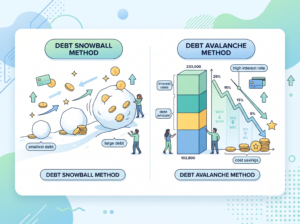
The Debt Snowball
- Pay minimums on everything, then throw every extra dollar at the smallest debt first.
- Once it’s gone, roll its payment into the next smallest, and so on.
- Best for: people who need quick wins and motivation. The psychological boost of eliminating a debt fast keeps you going.
The Debt Avalanche
- Pay minimums on everything, then throw extra money at the highest-interest debt first.
- Mathematically, this saves you the most money in interest.
- Best for: people who are numbers-driven and patient, who can stay motivated without early wins.
Both work. The “best” one is the one you’ll stick with. Compare them in detail in our debt snowball vs avalanche guide.
Step 4: Automate Every Payment
A plan only works if it actually happens. Set up autopay for at least the minimum on every debt so you never miss a payment (which protects your credit score — see our credit score explained guide). Then, separately, automate your “extra payment” toward your target debt so it happens before you can spend the money.
Automation removes the willpower requirement. If the money leaves your account automatically, you don’t have to decide to send it every month — and you can’t talk yourself out of it.
Step 5: Free Up More Money to Attack Debt
The faster you pay, the less interest you pay. Here are realistic ways to find extra cash without extreme sacrifice:
- Trim one subscription and redirect the savings to debt.
- Do a no-spend week once a month — eat from home, skip delivery.
- Sell unused items — electronics, clothes, furniture you don’t use.
- Redirect any windfall (tax refund, bonus, gift) straight to your target debt.
- Consider a side gig for a short, defined period (e.g., 6 months) and funnel it entirely to debt.
Even an extra $50–$100 a month dramatically shortens your payoff timeline and cuts total interest.
Step 6: Consider Whether Consolidation Makes Sense
If you have multiple high-interest debts, consolidating them into a single personal loan or debt consolidation loan with a lower rate can simplify payments and save interest — but it only works if you don’t run the balances back up. It’s not a fix by itself; it’s a tool. Learn when it’s a smart move in our personal loans explained guide and our debt consolidation guide.
Step 7: Stay on Track Without Burning Out
Debt payoff is a marathon, not a sprint. To sustain it:
- Celebrate every debt eliminated — even a small one. Acknowledging progress keeps you motivated.
- Build in one small enjoyment so the plan feels sustainable, not punishing.
- Review your plan monthly and adjust as your income or situation changes.
- Don’t compare your timeline to others. Your pace is your pace.
Common Mistakes That Slow Down Debt Payoff
Avoid these — they quietly extend your payoff by months or years:
- Only making minimum payments. This is how balances linger for years while interest compounds.
- Stopping your buffer to pay debt. Without it, one emergency pushes you back into new debt.
- Consolidating without changing habits. Rolling debts into one loan but reusing the empty cards creates a worse situation.
- Getting discouraged and quitting. A missed month isn’t failure — quitting is. Just resume next month.
- Ignoring interest rates entirely. If you insist on snowball, fine — but at least understand what avalanche would save you.
- Using a credit card while trying to get out of debt. New charges undo your progress. Freeze spending on cards during payoff.
Real-World Example: A Realistic Debt-Free Timeline
Let’s see the plan in action with a realistic scenario.
Maria: $8,000 in debt — $4,500 on a credit card (22% APR), $2,500 on a personal loan (12%), and $1,000 on a medical bill (0% if paid within 12 months).
Her plan:
- Month 0: She lists her debts, builds a $500 buffer, and sets up autopay minimums on everything.
- Months 1–4: Using the snowball, she attacks the $1,000 medical bill first (smallest), paying it off by month 4.
- Months 5–10: She rolls the medical payment + an extra $150/month into the $2,500 personal loan, paying it off around month 10.
- Months 11–20: She focuses everything on the $4,500 credit card, paying it off by roughly month 20.
By focusing, automating, and using extra cash, Maria becomes debt-free in about 20 months — well under the 5+ years it would take with minimum payments alone. For a deeper look at the exact math of payoff methods, see our debt snowball vs avalanche guide.

Frequently Asked Questions
What’s the fastest way to get out of debt?
The debt avalanche (highest interest first) saves the most money, so it’s mathematically fastest. But the debt snowball (smallest first) is often faster in practice because the motivation of early wins keeps you consistent. Pick the one you’ll stick with.
Should I pay off debt or save for an emergency first?
Build a small starter buffer of $500–$1,000 first, then attack debt aggressively. A tiny buffer prevents new debt from emergencies without derailing your payoff. Grow it to 3–6 months after you’re debt-free.
Is debt consolidation a good idea?
It can be, if you move high-interest debt to a lower-rate loan and stop using your old cards. It simplifies payments and saves interest. But it fails if you re-spend the credit. See our debt consolidation guide before deciding.
How much should I pay toward debt each month?
As much as you sustainably can beyond the minimums. Even an extra $50–$100/month meaningfully shortens your timeline. The goal is a consistent, non-punishing amount you can maintain.
Can I get out of debt on a low income?
Yes. The plan works on any income — it’s about prioritizing, automating, and finding even small extra cash. Low-income budgets just take longer and need more patience. The key is consistency, not the amount.
Will paying off debt hurt my credit score?
Paying off debt usually helps your credit, mainly by lowering your utilization ratio. Closing accounts can hurt, but simply paying them down and keeping them open is positive.
Key Takeaways
- Debt is a math problem, not a moral failure — it’s fixable with a plan.
- Get a complete picture of every debt, its balance, and its rate before starting.
- Build a small $500–$1,000 buffer first so emergencies don’t push you back into debt.
- Pick snowball or avalanche — the best method is the one you’ll stick with.
- Automate minimums and extra payments to remove willpower from the equation.
- Consolidate only if you’ll change the habits that caused the debt.
- Be consistent, not perfect. A missed month is fine; quitting isn’t.
Getting out of debt is one of the most freeing financial transformations you can make — and it starts with a single decision to see the full picture and commit to a plan. You don’t need to do it all at once. You just need to do it on purpose, step by step, month by month. The person you’ll be when that last payment clears will thank you.
Ready to build your plan? Start by choosing your payoff method with our debt snowball vs avalanche guide. If you’re considering restructuring, read when a personal loan or a debt consolidation loan makes sense. And if student loans are part of the picture, our student loan repayment options guide breaks down every path. Throughout, protect your progress by keeping an eye on your credit with our credit score explained guide. This article is for informational purposes only and is not financial advice.