


Why a Three-Digit Number Controls So Much of Your Financial Life
You’ve probably heard the phrase “check your credit score” a hundred times, but have you ever actually understood what that number is, who decides it, and why it can be the difference between getting a car loan at 4% or 18%? It feels like a secret scoreboard that some invisible judge keeps, and nobody explained the rules.
Here’s what makes it worth understanding: your credit score isn’t just about borrowing. It can raise or lower your insurance rates, decide whether you get approved for an apartment, and even affect what deposit a utility company asks for. A good score quietly saves you thousands of dollars a year; a bad one quietly costs you the same.
The good news? Your credit score isn’t random and it isn’t permanent. It’s calculated from a handful of factors you can actually control, and with the right plan, you can see meaningful improvement in as little as 30 to 60 days. This guide walks you through exactly what a credit score is, how it’s calculated, and the proven steps to raise yours — fast.
What Is a Credit Score, Really?
A credit score is a three-digit number — typically between 300 and 850 — that lenders use to predict how likely you are to repay borrowed money. It’s a snapshot of your financial history, boiled down to a single number.
The Two Big Names: FICO and VantageScore
The two scoring models you’ll encounter most are FICO and VantageScore. They weigh things slightly differently, but both look at the same core behaviors. Most lenders use FICO, which is why it’s the one you’ll hear about most. When you check a free score on an app or bank, you’re often seeing a VantageScore — the numbers can differ, but the story they tell about your credit health is the same.
The Score Ranges (What’s “Good” vs “Bad”)
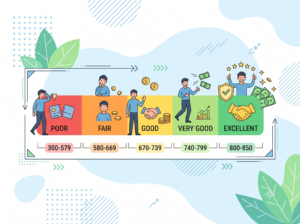
| Score Range | Rating | What It Means |
|---|---|---|
| 300–579 | Poor | Hard to get approved; high interest rates |
| 580–669 | Fair | Some approval, but expensive rates |
| 670–739 | Good | Most options open; reasonable rates |
| 740–799 | Very Good | Above-average rates and approvals |
| 800–850 | Excellent | Best available rates and terms |
Anything above ~740 puts you in the top tier for most lenders. You don’t need a perfect 850 to get great rates — you need to be solidly in the “very good” zone.
The 5 Factors That Make Up Your Credit Score
Your score isn’t one mystery number — it’s a weighted average of five specific factors. Once you know the weights, you know exactly where to focus your effort.
Payment History (35% of your score)
This is the single biggest factor. Lenders want to see that you pay your bills on time. Even one late payment can hurt, and a payment 30+ days late can stay on your report for years. This is the #1 reason to never miss a due date.
Credit Utilization Ratio (30%)
This is how much of your available credit you’re using. If you have a $1,000 limit and a $900 balance, you’re at 90% utilization — which looks risky to lenders. Keeping utilization low (under 30%, ideally under 10%) is one of the fastest ways to improve your score. We’ll cover this in detail because it’s the single quickest lever you can pull.
Length of Credit History (15%)
Older accounts are better. The longer you’ve responsibly used credit, the more trustworthy you look. This is why closing an old credit card can actually hurt your score — it shortens your average account age.
Credit Mix (10%)
Having different types of credit — like a credit card and an installment loan — shows you can handle various kinds of debt. You don’t need to take on debt just for this, but it’s a small factor to keep in mind.
New Credit Inquiries (10%)
Every time you apply for credit, a “hard inquiry” shows up on your report. Too many in a short period can lower your score, since it looks like you’re desperate for money. Space out applications and don’t apply for multiple cards at once.

The 7-Step Plan to Improve Your Credit Score Fast
Here’s the practical, action-based plan. Do these in order, and you’ll see real movement within a month or two.
Step 1: Check Your Credit Report for Errors
You can’t fix what you can’t see. Get your free credit report and scan it for mistakes — old accounts you didn’t open, incorrect late payments, or balances that aren’t yours. Errors are more common than you’d think, and disputing them can give your score an instant, legitimate boost.
Step 2: Pay Every Bill On Time (Going Forward)
Because payment history is 35% of your score, this is non-negotiable. Set up autopay for at least the minimum on every account. One missed payment is the fastest way to undo weeks of good work.
Step 3: Lower Your Credit Utilization Below 30%
If you’re using more than 30% of your available credit, pay it down. This is the fastest lever: because utilization can be recalculated every month, dropping it can improve your score within a single billing cycle. Get a statement detailing how to manage utilization in our guide to credit utilization ratio.
Step 4: Don’t Close Old Credit Cards
Keep your oldest accounts open, even if you don’t use them. They lengthen your credit history and boost your available credit — both of which help your score.
Step 5: Ask for a Credit Limit Increase
If you’re a responsible cardholder, you can often request a higher limit. Raising your limit automatically lowers your utilization ratio, as long as you don’t spend more to match it. (This works whether you hold a traditional card or a secured one — here’s how secured vs unsecured credit cards compare if you’re deciding what to open.)
Step 6: Become an Authorized User
If you have a trusted friend or family member with good credit, ask to be added as an authorized user on their card. Their good payment history can help build your credit history — without you even having to use the card. (If you’re just starting from zero, this pairs well with picking one of the best credit cards for beginners to build credit in the background.)
Step 7: Wait Out the Inquiries
Hard inquiries fade from most scoring models after 12 months. If you recently applied for a few things and took a small hit, it will recover on its own. Just stop applying for new credit for a while.
Common Credit Score Mistakes That Cost You Points
Avoid these mistakes — they’re all things people do regularly, not realizing the damage:
- Maxing out cards and carrying the balance. High utilization is a double penalty: it hurts your utilization ratio and costs you interest.
- Closing old cards to “clean up.” This shortens your credit history and lowers available credit — both negative.
- Applying for too much credit at once. Multiple hard inquiries in a short window signals risk.
- Only paying the minimum on high balances. Minimum payments barely dent high balances, keeping utilization high.
- Ignoring your credit report. Errors you never dispute keep hurting your score indefinitely.
- Checking your own score too often and panicking. (Don’t worry — checking your own score is a soft inquiry and doesn’t hurt you.)
Real-World Example: How Raising Your Score Saves Real Money
This is where it becomes concrete. Let’s look at two people borrowing the same $25,000 car loan.
Ana (FICO 620): A “fair” score. She’s approved, but her annual percentage rate is around 14%. Over a 5-year loan, she’ll pay roughly $9,800 in interest.
Ben (FICO 760): A “very good” score. He gets a rate near 6%. Over the same 5-year loan, he’ll pay roughly $4,000 in interest.
That’s a $5,800 difference — for the exact same car. Raising your credit score isn’t an abstract numbers game; it’s literally thousands of dollars in your pocket. This is why it’s worth the effort to move from “fair” to “good,” or from “good” to “very good.” (If you want to understand exactly how that interest is charged, our guide to how credit card interest works breaks down APR and compounding.)
[IMAGE #3 — place here] Prompt: “A warm, minimalist flat illustration of a person reviewing their credit score on a laptop at a desk, calm and approachable mood, soft warm lighting, muted color palette, faceless or stylized character (not photorealistic), cozy home-office setting, vector illustration style, 4:3 aspect ratio” Alt text: person reviewing their credit score on a laptop
Frequently Asked Questions
How fast can I improve my credit score?
Some improvements are nearly instant — like lowering your credit utilization, which can raise your score within one billing cycle. Other factors, like a missed payment aging off your report, take longer. Most people see meaningful movement within 30–90 days by following the steps above.
What is a good credit score?
Any score above 670 is generally considered “good,” and above 740 is “very good” — the point where you qualify for the best interest rates. You don’t need to chase a perfect score.
Does checking my credit score lower it?
No. Checking your own credit score is a “soft inquiry” and has zero impact on your score. Only “hard inquiries” — which happen when a lender checks your credit for an application — can affect it.
How many points does a late payment drop my score?
It varies by your starting score, but a single 30-day-late payment can drop a good score by 60 to 100 points. This is why autopay and calendar reminders are so important.
Should I pay off my credit card balance in full every month?
Yes, if you can. Paying in full each month avoids interest entirely and keeps your utilization low — two benefits at once. If you can’t pay in full, at least pay more than the minimum to bring your balance down faster.
Key Takeaways
- Your credit score is a weighted average of 5 factors — payment history (35%), utilization (30%), history length (15%), mix (10%), and new inquiries (10%).
- Payment history and utilization are the two you control most and should focus on.
- The fastest fix is lowering your utilization below 30% (ideally under 10%).
- Check your report for errors and dispute them — errors hurt you until fixed.
- Keep old accounts open, space out applications, and don’t chase a perfect score.
- Raising your score from “fair” to “good” can save you thousands in interest on loans.
Your credit score is one of the most valuable three-digit numbers you’ll ever own. It’s not a mystery — it’s a formula you can understand and improve. Start by checking your report, fix any errors, lower your utilization, and never miss a payment. Do those four things consistently, and your score will follow.
Ready to build your credit from here? If you’re just getting started, read about the best credit cards for beginners with no credit history. If you’re weighing how to open your first account, our comparison of secured vs unsecured credit cards explains the difference. Understand the cost side in our guide to how credit card interest works. And keep your score high by mastering your credit utilization ratio. Along the way, remember that all of this fits into a bigger picture — learn how to budget your money so your credit habits never turn into debt. This article is for informational purposes only and is not financial advice.