

If you’ve ever reached the end of the month wondering where your paycheck went, you’re not alone. Most people don’t overspend because they’re careless — they overspend because they’ve never had a system that tells them, in advance, where every dollar is supposed to go.
That’s what budgeting actually is: a plan that tells your money what to do before you spend it, instead of wondering afterward where it went. This guide walks you through exactly how to build a working budget from scratch, even if you’ve never tracked a single expense in your life — no shame, no jargon, no unrealistic “stop buying coffee” advice.
By the end of this article, you’ll know how to calculate your real income and expenses, choose a budgeting method that actually fits your personality, and build a monthly budget you can stick to for longer than two weeks.
What Budgeting Actually Means (And Why Most People Get It Wrong)
A budget is not a punishment. It’s not a spreadsheet that tells you to eat rice and beans for a year. At its core, a budget is simply a plan for your money that’s written down before the month begins — a way of deciding in advance what each dollar is for.
The most common reason budgets fail isn’t lack of discipline. It’s that people build a budget based on how they wish they spent money, not how they actually spend it. When the real numbers don’t match the plan, the whole system falls apart by week two, and people conclude “budgeting doesn’t work for me.” It’s not that budgeting doesn’t work — it’s that the specific method didn’t match their real spending patterns.
Why a Budget Matters Even If You’re Not “Bad With Money”
Even people with healthy incomes benefit from budgeting, because a budget does three things a bank balance alone never can:
- It shows you where your money is going, not just how much is left.
- It lets you plan for irregular expenses (car repairs, holidays, annual subscriptions) before they become emergencies.
- It creates a direct, visible link between your daily choices and your long-term goals — like paying off debt, building an emergency fund, or eventually investing for the first time.
How to Build a Budget: The Core Mechanics
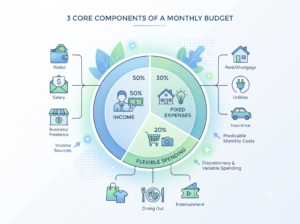
Every budgeting method — no matter how fancy the app or spreadsheet — is built from the same three ingredients. Understanding these first makes any method you choose later far easier to stick to.
1. Your Real Monthly Income
Not your salary. Your take-home pay — what actually lands in your bank account after taxes and deductions. If your income is irregular (freelance, hourly, commission-based), use your average income from the last 3–6 months, or budget off your lowest typical month to stay safe.
2. Your Fixed Expenses
These are costs that stay roughly the same every month: rent or mortgage, insurance premiums, loan payments, subscriptions, and phone bills. List every one of these with its exact amount — this is usually the easiest part of budgeting because the numbers rarely surprise you.
3. Your Flexible (Variable) Spending
This is where most budgets break: groceries, gas, dining out, entertainment, and miscellaneous purchases. These numbers change month to month, which is exactly why they need the most attention. The goal isn’t to guess a number — it’s to look at your last 60–90 days of bank and card statements and find your actual average.
Step-by-Step: How to Create Your First Budget

Step 1: Calculate Your Total Monthly Income
Add up every source of take-home income for the month. If it varies, use the average of your last three months. Write down one final number — this is your budget’s ceiling.
Step 2: List Every Fixed Expense
Go through your bank statement and write down every recurring, non-negotiable payment: rent, utilities, insurance, minimum debt payments, subscriptions. Add them up.
Step 3: Track (or Estimate) Your Variable Spending
Pull your last two to three months of transactions and sort them into categories: groceries, transportation, dining out, personal care, entertainment. Average each category across the months you reviewed. This step alone is where most people discover they’re spending 2–3x more than they assumed on things like takeout or subscriptions.
Step 4: Choose a Budgeting Method That Fits Your Personality
There’s no single “correct” method — the best one is whichever you’ll actually maintain. A few of the most reliable:
| Method | Best For | How It Works |
|---|---|---|
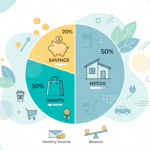
| 50/30/20 Rule | Beginners who want simplicity | 50% needs, 30% wants, 20% savings/debt |
| Zero-Based Budget | People who want full control | Every dollar is assigned a job until income minus expenses = $0 |
| Envelope/Cash-Stuffing | People who overspend with cards | Physical or digital “envelopes” cap spending per category |
| Pay-Yourself-First | People focused on savings goals | Savings is deducted first, the rest is free to spend |
For a deeper breakdown of the most popular option, read our full guide: The 50/30/20 Budget Rule Explained (With Real-Life Examples).
Step 5: Assign Every Dollar, Then Review Weekly
Once you’ve picked a method, assign a purpose to every dollar of income — including savings and “fun money.” A budget with zero flexibility usually fails within a month, so build in a small buffer category for the unexpected. Then review it weekly, not monthly. A five-minute Sunday check-in catches small overspending before it snowballs into a blown budget by the 25th.
Common Budgeting Mistakes to Avoid
- Being too restrictive too fast. Cutting every discretionary expense in week one almost always leads to a “budget binge” a few weeks later. Start with realistic, sustainable numbers and tighten gradually.
- Forgetting irregular expenses. Annual costs like car registration, holiday gifts, or an insurance premium due every six months are the #1 reason otherwise-solid budgets get blown. Divide annual costs by 12 and set that amount aside monthly.
- Not tracking at all after the first week. A budget is a living plan, not a one-time document. If you stop checking it, it stops working.
- Using the wrong tool for your personality. If spreadsheets stress you out, an app will serve you better, and vice versa — this is covered in detail in Budgeting Apps vs Spreadsheets: Which Is Better in 2026?
- Budgeting income you don’t reliably have. If you’re paid variable income, always plan around your lowest realistic month, not your best one.
- Skipping savings until “there’s money left over.” There almost never is. Treat savings like a fixed bill, not a leftover.
Real-World Example: A $3,200/Month Budget in Practice
To make this concrete, here’s how a single person earning $3,200/month take-home might build a working 50/30/20 budget:
Needs (50% = $1,600)
- Rent: $1,050
- Utilities & phone: $180
- Groceries: $280
- Minimum debt payments: $90
Wants (30% = $960)
- Dining out: $220
- Subscriptions & entertainment: $80
- Shopping/personal: $260
- Transportation (beyond commuting basics): $400
Savings & Debt Payoff (20% = $640)
- Emergency fund contribution: $300
- Extra debt payment: $200
- Retirement/investing: $140
Notice this isn’t a “perfect” budget — the “wants” category has real breathing room, because a budget that feels punishing rarely lasts. The key is that every dollar has a destination before the month starts, so there’s no guessing on day 20 whether there’s enough left for groceries.
If this person wanted to accelerate their progress, the $300 emergency fund contribution above is the exact starting point covered in our guide: Emergency Fund: How Much You Really Need and How to Build One Fast. And once 3–6 months of expenses are saved, that same monthly discipline is what makes it possible to start investing with little money without touching your safety net.
How Long Does It Take for a Budget to “Click”?
Most people need two to three full months before a budget starts to feel automatic rather than effortful. The first month is almost always the least accurate, because you’re still discovering your real spending patterns. Don’t judge the system based on month one — judge it based on month three, after you’ve adjusted your category amounts to match reality.
Frequently Asked Questions
How much of my income should I save each month?
A common benchmark is 20% of take-home income, split between an emergency fund and longer-term goals like retirement or debt payoff. If 20% isn’t realistic yet, even 5–10% consistently is far more valuable than an ambitious target you can’t sustain.
What’s the best budgeting method for beginners?
The 50/30/20 rule is generally the easiest starting point because it only requires three categories instead of ten or more. Once you’re comfortable, you can switch to a more detailed method like zero-based budgeting if you want tighter control.
Should I budget with cash or a card?
Either works — what matters is whether the method keeps you accountable. Cash/envelope systems create a hard physical limit that many overspenders find helpful, while card-based budgeting paired with a tracking app works well for people who don’t want to carry cash.
What if my income changes every month?
Budget around your lowest typical month rather than your average or best month. Any income above that baseline in a good month goes straight to savings or debt, rather than being pre-spent.
Do I need an app to budget successfully?
No — a budget can be built with a notebook, a spreadsheet, or an app. The right tool is whichever one you’ll actually open and update. See our full comparison in Budgeting Apps vs Spreadsheets: Which Is Better in 2026?
Key Takeaways
- A budget is simply a plan that tells your money where to go before the month starts — not a restriction on your life.
- Every budget is built from the same three pieces: income, fixed expenses, and variable spending.
- Choose a method that matches your personality (50/30/20, zero-based, envelope, or pay-yourself-first) rather than the “most popular” one.
- Track weekly, not monthly, and expect it to take 2–3 months before it feels automatic.
- Once your budget is stable, the next steps are building an emergency fund and tackling any existing debt — covered in our guide on how to save money on a low income if your budget currently feels too tight to work with.
This article is for informational and educational purposes only and is not personalized financial advice. Consider speaking with a licensed financial professional for guidance specific to your situation.