

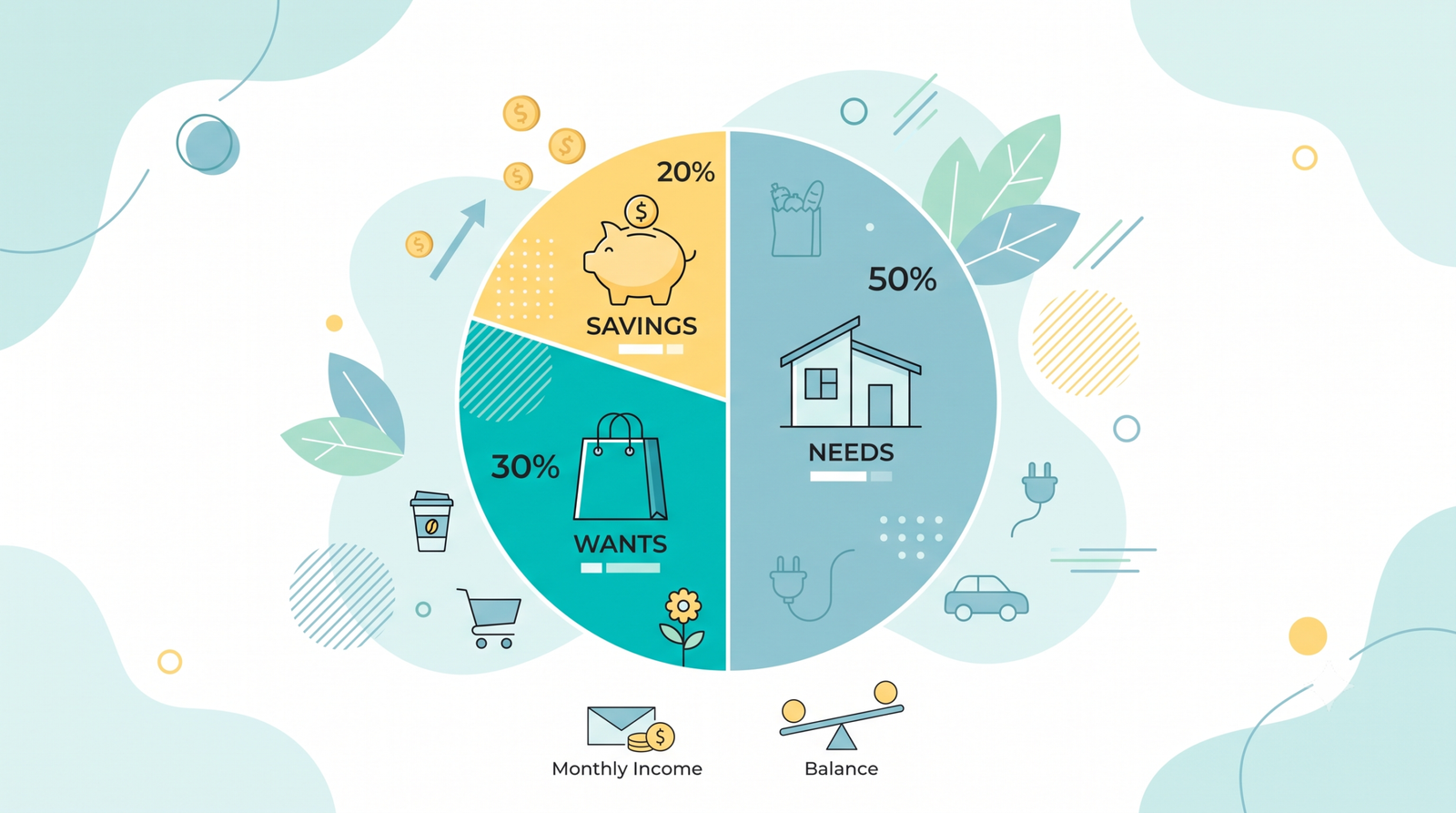

50/30/20 If you’ve ever searched for a simple way to organize your money, chances are you’ve run into the 50/30/20 rule. It’s one of the most recommended budgeting frameworks for a reason: it doesn’t require ten spending categories, a finance degree, or hours of tracking to get started. It just asks you to sort your spending into three buckets.
This guide breaks down exactly what the 50/30/20 rule is, how to calculate your own version of it, where it tends to go wrong, and how to adjust it when your rent is 60% of your income and the “textbook” numbers just don’t work.
If you haven’t built a budget before, it’s worth first reading our complete guide on how to budget money — this article assumes you already understand the basics and want to go deeper on one specific method.
What Is the 50/30/20 Rule?
The 50/30/20 rule is a budgeting framework that divides your after-tax (take-home) income into three categories:
- 50% — Needs: Rent or mortgage, utilities, groceries, insurance, minimum debt payments, transportation to work
- 30% — Wants: Dining out, entertainment, subscriptions, shopping, hobbies, vacations
- 20% — Savings & Debt Repayment: Emergency fund, retirement contributions, extra debt payments beyond the minimum
The idea, popularized by U.S. Senator Elizabeth Warren in her 2005 book All Your Worth, is that this ratio keeps your essential bills manageable, gives you permission to enjoy some of your money, and still guarantees consistent progress toward savings and debt-free goals — all without requiring a dozen micromanaged categories.
Why It Works So Well for Beginners
The biggest reason the 50/30/20 rule succeeds where more detailed budgets fail is simplicity. You only need to sort expenses into three buckets instead of remembering whether a coffee counts as “dining” or “miscellaneous.” Fewer categories means fewer decisions, and fewer decisions means you’re more likely to actually keep doing it past week two.
How to Calculate Your Own 50/30/20 Budget
 Step 1: Find Your Monthly Take-Home Pay
 Step 1: Find Your Monthly Take-Home Pay
Use your actual after-tax income, not your gross salary. If your income varies, use your average from the last three months or your lowest typical month to stay conservative.
Step 2: Multiply by Each Percentage
Take your monthly take-home income and multiply it by 0.50, 0.30, and 0.20 to get your three target amounts. For example, on a $4,000/month take-home income:
| Category | Percentage | Amount |
|---|---|---|
| Needs | 50% | $2,000 |
| Wants | 30% | $1,200 |
| Savings/Debt | 20% | $800 |
Step 3: Sort Your Existing Expenses Into the Three Buckets
Go through your last month of bank and card statements and assign every transaction to Needs, Wants, or Savings. This step is usually where people get their first real wake-up call — many discover their “needs” spending is already eating 65–70% of their income before they’ve spent a cent on anything else.
Step 4: Compare Your Real Numbers to the Target Percentages
If your Needs category is running higher than 50%, that’s useful information — it tells you either your fixed costs need to shrink (a cheaper apartment, a better insurance rate, a lower-payment car) or you need to adjust the ratio itself, which we’ll cover below.
Real-Life Example: 50/30/20 on a $4,000/Month Income
Needs — $2,000 target
- Rent: $1,150
- Utilities & phone: $190
- Groceries: $340
- Car payment & insurance: $260
- Minimum debt payments: $60
- Total Needs: $2,000 right on target
Wants — $1,200 target
- Dining out: $280
- Subscriptions: $65
- Shopping: $310
- Entertainment & hobbies: $220
- Miscellaneous: $200
- Total Wants: $1,075 — under target, leaving $125 of flexibility
Savings & Debt — $800 target
- Emergency fund: $350
- Retirement contribution: $250
- Extra debt payment: $200
- Total Savings: $800 right on target, plus the $125 leftover from Wants can be added here
This example works cleanly because rent is a reasonable 29% of take-home pay. That’s the exact scenario where the textbook version of the 50/30/20 rule holds up well — but it doesn’t always play out this neatly, especially in higher cost-of-living areas.
What to Do When 50/30/20 Doesn’t Fit Your Real Numbers
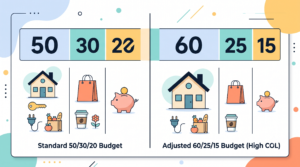
This is the most common criticism of the 50/30/20 rule, and it’s a fair one: in many high-cost cities, rent alone can eat 40–50% of take-home pay before utilities, groceries, or transportation are even factored in. If that’s your situation, the percentages aren’t a failure on your part — they’re a signal to adjust the framework rather than abandon budgeting altogether.
Practical adjustments that keep the spirit of the rule intact:
- Shift to 60/20/20 or 65/15/20 if your Needs category genuinely can’t fit into 50% — the priority becomes protecting the 20% savings number, even if it means trimming Wants further.
- Treat “20% savings” as a floor, not a ceiling. Even 10% consistently saved is far better than an unrealistic 20% target that collapses within a month.
- Revisit your Needs category for hidden Wants. People are often surprised to find subscription services, premium phone plans, or a car payment bigger than necessary tucked inside their “needs,” inflating that category artificially.
- If your income is below what covers 50% needs comfortably, our guide on how to save money on a low income walks through 20 additional strategies specifically for tighter budgets where the standard percentages don’t apply cleanly.
Common Mistakes With the 50/30/20 Rule
- Treating debt minimums as “needs” and extra debt payments as optional. Minimum payments belong in Needs, but any extra payment toward debt should come from the 20% Savings/Debt category, not get lost in Wants.
- Miss-categorizing subscriptions. Streaming services, apps, and memberships are almost always Wants, even when they feel routine.
- Giving up because the percentages don’t match perfectly in month one. The exact ratio matters far less than the habit of intentionally splitting spending into three purposeful categories.
- Forgetting irregular annual expenses. Costs like car registration or annual insurance premiums should be divided by 12 and folded into the Needs category monthly, not treated as a surprise later.
- Applying the rule to gross income instead of take-home pay. This inflates every target number and sets you up to feel like you’re failing a budget you never actually had enough money to meet.
Is the 50/30/20 Rule Right for Everyone?
The 50/30/20 rule tends to work best for people who:
- Are new to budgeting and want a system simple enough to actually maintain
- Have a relatively stable, predictable income
- Don’t yet have significant high-interest debt that needs an aggressive payoff plan
It tends to work less well for people who are aggressively paying off debt (who may need a higher percentage than 20% going toward payoff), people with highly irregular income, or people in very high cost-of-living areas where Needs realistically exceed 50%. In those cases, the percentages are a starting point to adjust, not a rule to force your life into.
Frequently Asked Questions
Is the 50/30/20 rule based on gross or net income?
It’s based on net (take-home) income — what actually lands in your bank account after taxes and deductions, not your salary before taxes.
What if my rent alone is more than 50% of my income?
This is common in high-cost cities. Rather than abandoning the framework, adjust the ratio (for example, 60/20/20) while keeping the core principle: protect a consistent savings percentage even if it’s smaller than 20%.
Does the 50/30/20 rule include debt payments?
Minimum debt payments count as a “need.” Any additional, extra payments beyond the minimum should be counted in the 20% savings/debt category.
Can I use the 50/30/20 rule if my income is irregular?
Yes — apply the percentages to your average income from the last few months, or your lowest typical month, and treat any income above that as a bonus that goes straight to the Savings category.
What’s the difference between the 50/30/20 rule and other budgeting methods?
The 50/30/20 rule uses just three broad categories, making it simpler than methods like zero-based budgeting, which requires assigning every dollar to a specific line item. It’s a strong starting method covered in more detail in our full guide to how to budget money.
Key Takeaways
- The 50/30/20 rule splits take-home income into 50% Needs, 30% Wants, and 20% Savings/Debt.
- It’s one of the simplest and most beginner-friendly budgeting frameworks because it requires only three categories.
- If your Needs category genuinely exceeds 50% due to cost of living, adjust the ratio rather than abandon the method — protecting a consistent savings percentage matters more than matching the exact numbers.
- Common mistakes include miss-categorizing debt payments and subscriptions, and forgetting to divide annual expenses into monthly amounts.
- Pair this method with our full guide on how to budget money for the complete step-by-step setup process, or see how to save money on a low income if the standard percentages feel out of reach right now.
This article is for informational and educational purposes only and is not personalized financial advice. Consider speaking with a licensed financial professional for guidance specific to your situation.