

The Two-Word Debate That Decides How You’ll Pay Off Debt
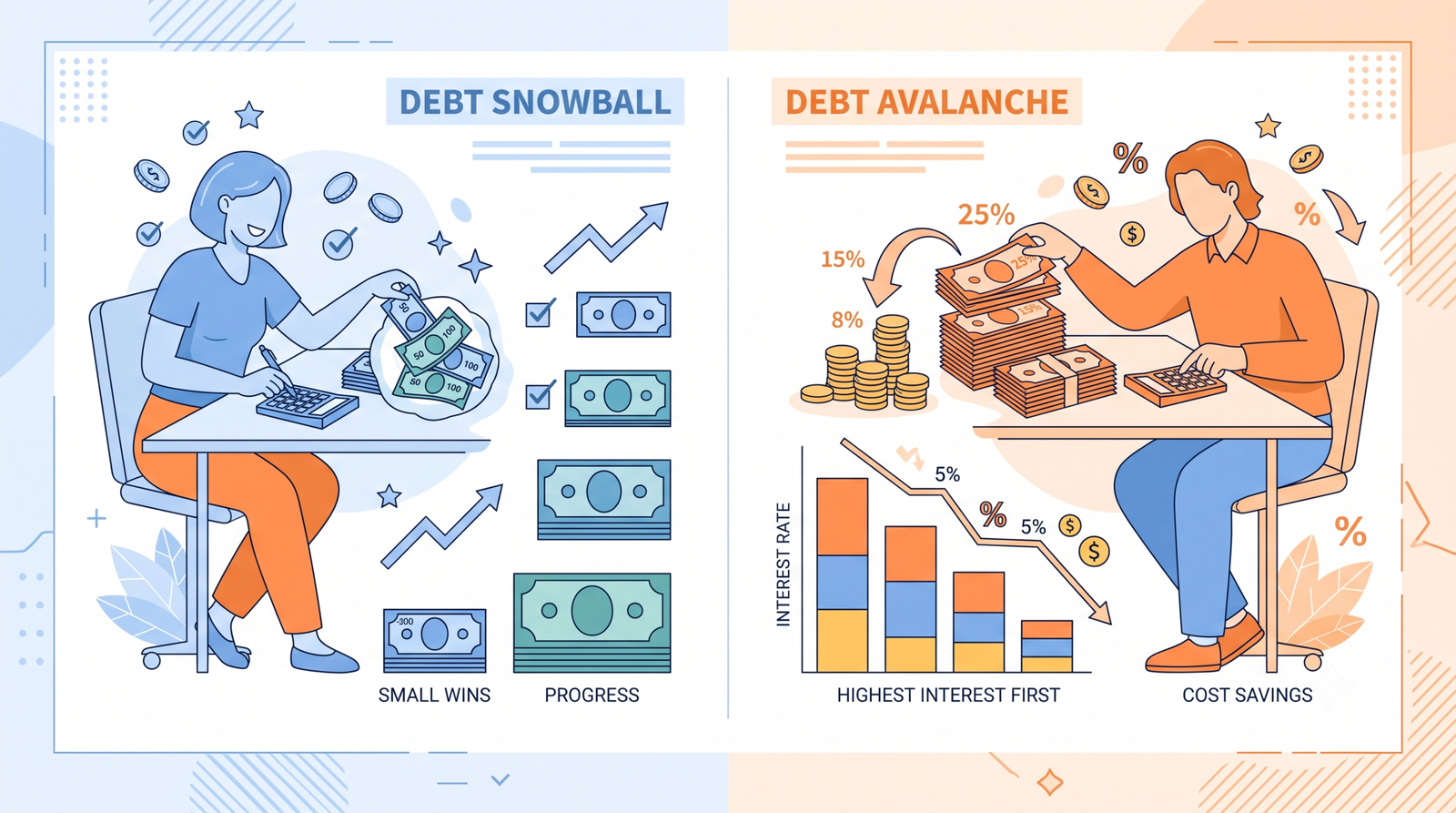
There’s a long-running argument in the personal finance world, and if you’re in debt, you’ve probably heard both sides. One camp swears by the debt snowball — pay off your smallest debts first for the rush of quick wins. The other insists the debt avalanche — attack the highest interest rate first — is mathematically superior and anything else is leaving money on the table.
So who’s right? The frustrating answer is: both, and neither. Each method genuinely works, and they both produce the same outcome if you stick with them. The real question isn’t “which is faster on paper” — it’s “which one will you actually follow through on, especially when motivation dips?”
This guide compares them side by side with real numbers, shows you exactly how each works, and helps you decide which one fits your personality — because the method you can sustain is the one that actually gets you out of debt.
How the Debt Snowball Works
The debt snowball is simple: pay off your smallest debt first, regardless of interest rate.
The Steps
- List all your debts from smallest balance to largest.
- Make minimum payments on everything except the smallest debt.
- Throw every extra dollar at that smallest debt until it’s gone.
- Once it’s paid off, roll its entire payment (minimum + extra) into the next smallest debt.
- Repeat — your payment “snowballs” larger with each debt you eliminate.
Why People Love It
- Quick wins. Paying off a $300 card feels great and gives you momentum.
- Psychological motivation. Seeing debts disappear fast keeps you going when the process feels long.
- Simple to follow. Ordering by balance is easier to stick with than tracking interest rates.
The Trade-Off
You may pay more total interest because you’re ignoring high rates. If your biggest-balance debt is also your highest rate, you’ll be paying that expensive interest while you chip away at cheaper, smaller debts first.
How the Debt Avalanche Works
The debt avalanche is all about math: pay off the debt with the highest interest rate first.
The Steps
- List all your debts from highest interest rate to lowest.
- Make minimum payments on everything except the highest-rate debt.
- Throw every extra dollar at that highest-rate debt until it’s gone.
- Roll its payment into the next-highest-rate debt, and so on.
Why People Love It
- Saves the most money. By attacking high rates first, you minimize the total interest you pay across all debts.
- Mathematically optimal. There’s no faster way to become debt-free for the same monthly payment.
- Rewards discipline. It’s the “correct” choice for numbers-driven people.
The Trade-Off
- Slower visible progress. If your highest-rate debt is also your largest, it may take a while before you get to eliminate any single debt — which can be demotivating.
- Requires more patience. Without early wins, some people lose steam and quit.
Debt Snowball vs Debt Avalanche: Side-by-Side
| Factor | Debt Snowball | Debt Avalanche |
|---|---|---|
| Order by | Smallest balance first | Highest interest rate first |
| Total interest paid | Higher (usually) | Lower (saves the most) |
| Time to first “win” | Fast (small debts vanish quickly) | Slower (may take months) |
| Motivation style | Psychological — quick wins | Mathematical — knowing it’s optimal |
| Best for | People who need momentum | Patient, numbers-driven people |
| Risk | May pay more interest | May lose motivation and quit |
The Real Numbers: Which Is Actually Faster?
Let’s settle the “faster” question with a concrete example. These are the debts:
| Debt | Balance | Interest Rate |
|---|---|---|
| Credit Card A | $2,000 | 24% |
| Credit Card B | $5,000 | 18% |
| Personal Loan | $8,000 | 8% |
Assume you have $700/month total to put toward debt, minimum payments excluded for simplicity.
With the Snowball (smallest balance first)
- Order: Card A ($2,000) → Card B ($5,000) → Loan ($8,000)
- Card A vanishes in ~3 months (quick win!).
- You roll its $700 into Card B, then the loan.
- Total interest paid: roughly $2,050. Debt-free in about 23 months.
With the Avalanche (highest rate first)
- Order: Card A (24%) → Card B (18%) → Loan (8%)
- Same first target here, but if rates and balances differed, you’d pick by rate.
- Total interest paid: roughly $1,980. Debt-free in about 22 months.
The verdict in this example: the avalanche saves about $70 and one month. Not huge — but over larger, longer debts, the gap widens to hundreds or thousands of dollars.
When the Gap Really Matters
If your high-interest debt is large, the avalanche can save thousands. But if the savings is small (like above) and you’d be more motivated by the snowball’s quick wins, the snowball is the better choice — because a method you stick with beats an optimal one you quit.
How to Decide: Which Method Is Right for YOU?
Ask yourself these four questions.
1. Do you need quick wins to stay motivated?
If the thought of paying the same big debt for a year without eliminating anything demotivates you, choose the snowball. The early victories will keep you going long enough to finish.
2. Are you comfortable with math and patience?
If you’re numbers-driven, can delay gratification, and want to save the most interest, choose the avalanche. You’ll be paid off slightly faster and cheaper — if you stick with it.
3. What’s the actual interest gap in your situation?
Run the numbers on your debts. If the avalanche saves you a few dollars a month, the snowball’s motivation might be worth more. If it saves you hundreds a year, the avalanche is hard to ignore.
4. Have you tried one and quit before?
If you’ve started and stopped, go with whichever method you haven’t tried, or simplify it. Consistency is the real winner in every debt story. (For the complete plan either method fits into, see our step-by-step guide to getting out of debt.)
Common Mistakes With Payoff Methods
Avoid these — they’re the difference between a plan that works and one that stalls:
- Switching methods every few months. Pick one, commit for at least 6 months, and reassess. Constant switching resets your progress.
- Ignoring minimums on other debts. You must keep paying the minimum on everything else, or late fees and score damage wipe out your gains.
- Using the credit cards you’re paying off. New charges undo your progress. Freeze card spending during payoff.
- Not building a small buffer first. Without $500–$1,000 saved, an emergency pushes you back into new debt.
- Being inflexible. If you’re burning out on the avalanche, switching to the snowball (or vice versa) is fine — better than quitting.
Real-World Example: Two People, Same Debts, Different Methods
Let’s see how the choice plays out for two people with identical debts.
Ravi (snowball): Owed $1,200 (card), $4,000 (loan), and $6,500 (high-rate card). He attacked the $1,200 first, paid it off in two months, and the win fueled him. He paid off everything in 30 months, with about $1,600 in total interest.
Priya (avalanche): Same debts, but she went after the high-rate card first. It took her six months to kill that first (large) debt, but she saved more interest overall. She finished in 28 months, paying about $1,400 in interest.
Priya finished faster and cheaper; Ravi enjoyed more early wins. Neither is wrong. Both got out of debt, which is what matters. (Understanding the interest behind these numbers? See our guide to how credit card interest works.)
Frequently Asked Questions
Which debt payoff method is best?
The one you’ll stick with. The avalanche saves the most money and is mathematically fastest; the snowball provides quick wins that keep many people motivated. Choose based on your personality, not just the math.
Is the debt avalanche always faster?
On paper, yes — it saves the most interest, so for the same monthly payment it gets you debt-free slightly faster. But if you lose motivation and quit, the “slower” snowball would have been faster in practice.
What’s the difference between snowball and avalanche?
Snowball orders debts by smallest balance first; avalanche orders them by highest interest rate first. Same payment amounts, different order of attack.
Should I consolidate before using these methods?
Consolidation can simplify payments or lower your rate, but it’s a separate decision from the snowball/avalanche order. You can combine them. Learn more in our personal loans explained guide.
Can I use the snowball if I’m mathematically inclined?
Yes — the snowball isn’t “wrong,” it just costs more in interest. If you value the motivation over the savings, that’s a legitimate trade-off. Awareness of the cost is what matters.
How long does it take to pay off debt with these methods?
It depends on your total debt and how much you can pay monthly. Many people finish in 1–3 years with consistent extra payments, versus a decade or more with minimums alone.
Key Takeaways
- Snowball = smallest balance first → quick wins, more interest.
- Avalanche = highest rate first → saves the most, less visible progress.
- Both work and produce the same goal: being debt-free.
- Choose the one you’ll sustain — consistency beats optimization.
- Keep paying minimums on all other debts during payoff.
- Build a small buffer first so emergencies don’t push you back into debt.
The snowball vs avalanche debate misses the point if it keeps you from starting. The real victory isn’t picking the “best” method — it’s picking a method and following it through. Whether you want the emotional boost of quick wins or the cold logic of maximum savings, both roads lead to the same destination: a debt-free life. Pick yours, automate your payments, and let consistency do the work.
Ready to build your full plan? See how both methods fit into the complete step-by-step guide to getting out of debt. If you’re weighing whether a personal loan or a debt consolidation loan could speed things up, those guides cover it. And understand the interest you’re fighting with our guide to how credit card interest works. This article is for informational purposes only and is not financial advice.