

The $1,200 Bill Nobody Warns You About
Imagine you charge $3,000 on a credit card during a rough month — a car repair, some medical bills, a few groceries. You can’t pay it off right away, so you figure you’ll chip away at it with the minimum payment. What could that cost, right?
Here’s what nobody explains: with a typical credit card APR around 24%, paying only the minimum on that $3,000 balance means you’ll be paying for over 10 years and roughly $1,200 in interest — on top of the $3,000 you already owe. That’s the true, hidden cost of credit card interest, and it’s why understanding it is one of the most valuable money skills you can learn.
The good news? You can completely avoid paying credit card interest if you understand three simple things: what APR actually means, how a grace period works, and the one habit that keeps you interest-free forever. This guide breaks it all down in plain English.
What Is APR, Really?
APR stands for Annual Percentage Rate — the yearly cost of borrowing on your card, expressed as a percentage. But there’s a catch that surprises most people: while it’s quoted as a yearly rate, credit card interest is actually charged daily.
Here’s how it works in practice. Your bank takes your APR and divides it by 365 to get a daily periodic rate. So if your APR is 24%, your daily rate is about 0.066% (24 ÷ 365). Each day, the bank multiplies your current balance by that daily rate and adds the interest to what you owe. The next day, interest is charged on the new total — including yesterday’s interest. That’s compounding, and it’s exactly how a small balance can snowball.
Why APR Matters Less Than You Think
Here’s a secret most cardholders miss: APR only matters if you carry a balance. If you pay your statement in full every month, the interest rate is irrelevant — you never pay a cent of it. That single insight is the key to never paying interest, and we’ll come back to it.
The Grace Period: Your Interest-Free Window
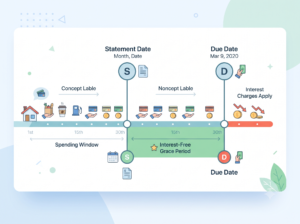
This is the most important concept to understand. A grace period is the window between the end of your billing cycle and your payment due date — typically 21 to 25 days.
How It Works
- Your billing cycle runs for about a month.
- At the end, you get a statement showing your “current balance” and a due date (roughly 3 weeks later).
- If you pay that full current balance by the due date, you pay no interest on those purchases.
That interest-free window is the grace period. It’s essentially an interest-free loan from your bank for up to roughly 55 days (a month of spending + the grace period).
When You Lose the Grace Period
Here’s the trap: if you don’t pay your full balance, you lose the grace period on new purchases. From that point, new purchases start accruing interest immediately, and you’re now paying interest on the daily balance. This is why carrying a balance is so expensive — you’re not just paying interest on what you owe; you’re also paying it on everything new you charge.
How Interest Is Actually Calculated (With Real Numbers)
Let’s make this concrete with a worked example using the daily compounding method most cards use.
The scenario: You have a card with a 24% APR. You carry an average daily balance of $1,000 for a month (30 days).
- Daily rate: 24% ÷ 365 = 0.0658%
- Daily interest: $1,000 × 0.000658 = $0.66
- Monthly interest (30 days): roughly $19.78
So carrying that $1,000 balance for a month costs you about $20 in interest — and that’s before compounding kicks in on top. Stretch it over a year, and that $1,000 balance costs you about $240. The math is straightforward once you see it.
The Compounding Snowball
If you only make minimum payments, compounding accelerates. Interest is charged on interest, the balance shrinks slowly (minimuMs often barely cover the interest), and the debt lingers for years. This is exactly how a manageable balance becomes an overwhelming one — see our guide to getting out of debt if this is already happening to you.
The 6 Habits That Keep You Interest-Free Forever
These are the exact habits that let you use credit cards as a tool rather than a trap.
Habit 1: Always Pay the Full Statement Balance
This is the golden rule. Pay the entire “current balance” by the due date every month. If you do this, you never pay interest, period. It doesn’t matter what your APR is.
Habit 2: Set Up Autopay for the Full Balance
Remove the risk of forgetting. Set your card to automatically pay the full statement balance each month. Just make sure your checking account has the funds — overdraft fees are cheaper than credit card interest, but still avoidable.
Habit 3: Don’t Charge More Than You Can Pay Off
Treat your credit card like a debit card. Only charge what you could pay for in cash that month. If you don’t have the money, don’t put it on the card.
Habit 4: Understand When the Grace Period Applies
Remember, the grace period only protects you if you pay in full. The moment you carry a balance, new purchases start accruing interest immediately. So if you can’t pay in full one month, stop using the card until you’re caught up.
Habit 5: Watch for Cash Advances
Cash advances from your credit card are different: they usually have no grace period, a higher rate, and a fee (often 3–5%). Avoid cash advances entirely if you want to stay interest-free.
Habit 6: Know Your Card’s Terms
Read the fine print on your statement’s APR section. Some cards have a variable APR that changes with the prime rate, and promotional 0% intro APRs eventually expire. Knowing your real APR helps you plan.
Common Mistakes That Lead to Paying Interest
Avoid these — each one can cost you real money:
- Paying only the minimum. This is how a $3,000 balance becomes $1,200 in interest over a decade.
- Thinking APR is a flat yearly charge. It compounds daily, so small balances grow faster than you expect.
- Using the card during a “balance-carrying” month. New purchases lose their grace period and accrue interest immediately.
- Taking cash advances for convenience. No grace period + fees + high APR = the most expensive way to use a card.
- Not knowing when your 0% intro APR ends. After the promo, your balance accrues interest at the regular rate.
- Letting autopay fail due to insufficient funds. A missed autopay can trigger a late payment on top of interest.
Real-World Example: The Cost of Minimum Payments
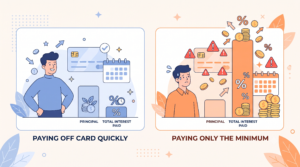
Let’s see the difference between two people who both charged $3,000 at 24% APR and stopped using their cards.
Noor (pays it off quickly): Noor puts an extra $200 toward her card every month on top of the minimum. She’s debt-free in about 17 months and pays roughly $560 in interest.
Omar (pays only the minimum): Omar pays just the minimum each month. Because the minimum barely exceeds the interest, it takes him about 11 years to pay off the same $3,000, and he pays roughly $2,500 in interest.
Same debt, wildly different outcomes — purely because of how quickly each paid it down. Understanding this single concept is the difference between staying interest-free and getting trapped, and it’s all part of the bigger picture in our credit score explained guide.
Frequently Asked Questions
How is credit card interest calculated?
Most cards use a daily periodic rate: your APR divided by 365, applied to your average daily balance each day, with interest compounded. You only pay interest if you carry a balance past the due date.
Is there a way to never pay credit card interest?
Yes. Pay your full statement balance by the due date every month. If you do that, the grace period means you pay zero interest on purchases, regardless of your APR.
What’s the difference between APR and interest rate?
On credit cards, they’re essentially the same thing — APR is the annual percentage rate, the yearly cost of borrowing. The key nuance is that it’s actually charged daily through compounding.
How long is a credit card grace period?
Usually 21 to 25 days, from the end of your billing cycle to your payment due date. It only applies if you pay your full balance; carrying a balance cancels it on new purchases.
Why did I get charged interest if I paid more than the minimum?
Because paying more than the minimum isn’t the same as paying the full balance. As long as any balance remains, interest accrues — and if you didn’t pay the full statement balance, you also lost the grace period on new purchases.
Is a cash advance charged the same interest rate?
No. Cash advances typically have a higher APR, a transaction fee (3–5%), and no grace period — interest starts immediately. They’re the most expensive way to use a credit card.
Key Takeaways
- APR is charged daily and compounds — that’s how small balances snowball.
- The grace period gives you an interest-free window of ~21–25 days — but only if you pay in full.
- Pay the full statement balance every month and you never pay interest, no matter the APR.
- Avoid cash advances — no grace period, higher rate, plus fees.
- Minimum payments are the enemy — they stretch debt into years of interest.
- Paying down quickly can save you thousands versus paying only the minimum.
Credit card interest isn’t complicated once you understand the rules — but the rules can be brutal if you don’t. The single most powerful habit you can build is to pay your full statement balance every single month. Do that, and your card becomes a convenient tool that never costs you a cent. Understanding interest also protects your credit — see our credit score explained guide for the full picture, and keep your balances low with our credit utilization ratio guide so you qualify for better cards. If you’re already stuck carrying a balance, our guide to getting out of debt gives you a realistic way out. And remember, this article is for informational purposes only and is not financial advice.