



he Credit Score Lever Most People Never Touch
Here’s a strange fact: you can do everything right on your credit report — pay every bill on time, never miss a payment — and still have a frustratingly average score. Meanwhile, someone else with a similar history keeps climbing. What are they doing differently?
The answer is often a single number you’ve probably never heard of: your credit utilization ratio. It’s the second-most-important factor in your credit score (worth about 30% of it), and unlike most credit factors that take years to fix, you can move it dramatically in a matter of weeks. It’s the fastest, most controllable lever in all of credit scoring — yet most people don’t even know it exists.
This guide explains what credit utilization is, why it matters so much, the exact percentage that gives you the best score, and the practical tricks to keep it low.
What Is Credit Utilization Ratio?
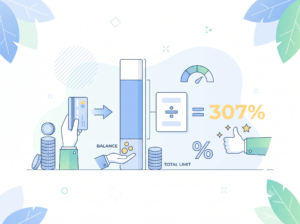
Your credit utilization ratio is simply how much of your available credit you’re currently using, expressed as a percentage. It answers the question: “How close are you to maxing out your credit cards?”
How to Calculate It
The formula is easy:
(Total credit card balances) ÷ (Total credit limits) × 100 = utilization ratio
So if you have two cards — one with a $500 balance and a $1,000 limit, and another with a $300 balance and a $2,000 limit — your calculation looks like this:
- Total balances: $500 + $300 = $800
- Total limits: $1,000 + $2,000 = $3,000
- Utilization: $800 ÷ $3,000 = 26.7%
That 26.7% is your overall utilization ratio.
Two Kinds of Utilization
- Overall utilization: Your total balances across all cards divided by your total limits. This is the number that matters most.
- Per-card utilization: Each card’s individual ratio. High utilization on even one card can hurt, even if your overall number looks fine.
Why Utilization Is Worth 30% of Your Score
Here’s the reasoning behind why lenders (and the scoring models) care so much: your utilization is the best signal of how risky you are right now. Someone using 90% of their available credit looks like they’re stretched thin and might struggle to repay. Someone using 10% looks like they’re in control, even if their total debt is similar.
Payment history (35%) tells lenders how you’ve behaved in the past. Utilization (30%) tells them how you’re doing right now. That’s why it moves so quickly — because it reflects your current situation, not your history. You can’t change your payment history overnight, but you can change your utilization in a single month. For the full breakdown of all five factors, see our credit score explained guide.
What’s the Ideal Credit Utilization Percentage?
The most commonly cited rule is to keep your utilization under 30%. But here’s the nuance that separates good credit managers from great ones:
The Tiers
| Utilization | Effect on Score |
|---|---|
| Under 10% | Best — maximum scoring benefit |
| 10%–30% | Good — very little downside |
| 30%–50% | Noticeable drag on your score |
| Above 50% | Significant damage |
| Close to 100% | Severe damage; looks risky |
The short answer to “what’s the ideal percentage?” is under 10%, with the sweet spot often cited as between 1% and 10%. It’s worth noting that having some balance (even 1–9%) tends to score slightly better than having a flat 0%, because it shows active, responsible use. But don’t overthink it — staying under 10% is the goal, and under 30% is the safe minimum.
The “30% Rule” Is a Floor, Not a Target
Most people hear “keep it under 30%” and assume 29% is great. In reality, 30% is the ceiling you should stay below, not the number to aim for. If you can comfortably stay under 10%, your score will thank you.
7 Practical Ways to Lower Your Utilization Fast
Because utilization is recalculated as your balance and limit change, you can lower it quickly. Here’s how.
1. Pay Down Your Balances
The most direct fix. Paying down what you owe drops your balance and your utilization in the same move. If you’re carrying debt, this also pairs with a smart payoff plan — see our guide to getting out of debt for the strategy.
2. Pay Before the Statement Closes
Here’s a powerful trick: the utilization that gets reported to the credit bureaus is based on your balance on your statement date, not when you pay. So if you pay your balance before the statement closes each month, your reported utilization can be near zero even if you use the card daily. Just don’t let that encourage overspending.
3. Ask for a Higher Credit Limit
Raising your limit automatically lowers your utilization, as long as you don’t spend more to match it. Many issuers allow a limit increase request with a soft inquiry that doesn’t hurt your score.
4. Don’t Close Old Cards
Closing a card removes its credit limit from your total, which raises your utilization. Keep old, zero-balance cards open to preserve your available credit.
5. Spread Your Spending Across Cards
If one card is at 80% and another is at 0%, your overall number is lower than the 80% card suggests — but the high per-card ratio still looks bad. Spreading balances can help, though paying down is more effective.
6. Use a Single Card Strategically
Conversely, for someone just starting out, using one small card and keeping it low is often the cleanest path — see our best credit cards for beginners for how to start light.
7. Watch Your Timing Around Big Purchases
If you’re about to apply for a loan (car, house), avoid large credit card charges in the weeks before. A high utilization snapshot right before a lender checks your credit can hurt your approval odds.
Common Mistakes With Credit Utilization
Avoid these — they’re all easy to fall into:
- Maxing out a card even when you “pay it off monthly.” Your statement-date balance still gets reported. Pay before the statement closes to avoid a high snapshot.
- Closing old cards to “clean up.” This raises your utilization and shortens your history — double negative.
- Thinking 30% is the goal. It’s the floor to stay under; under 10% is better.
- Not realizing per-card utilization matters. One maxed card can hurt even if your overall number is fine.
- Raising your limit then spending more. This defeats the purpose and can spiral into debt.
- Only looking at overall, not each card. Review both your total and per-card ratios.
Real-World Example: The Same People, Different Utilization
Let’s see how utilization changes the game for two people with identical income and payment history.
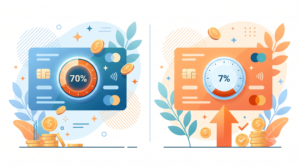
Sam: Has a $5,000 total limit and a $3,500 balance — a 70% utilization ratio. Even with a spotless payment history, Sam’s score is held back because lenders see someone using most of their available credit.
Jordan: Has the same $5,000 limit but keeps a $350 balance — a 7% utilization ratio. Same payment history, same income. But Jordan’s score is meaningfully higher because the utilization signals control and low risk.
Neither changed their payment behavior. Jordan just keeps utilization low, and it pays off in a better score — which translates to better rates on loans, as explained in our credit score explained guide. And the interest you avoid by keeping balances low? That’s covered in our guide to how credit card interest works.
Frequently Asked Questions
What is a good credit utilization ratio?
Under 30% is the standard minimum, but under 10% gives you the maximum scoring benefit. The ideal is roughly 1%–10% of your available credit in use.
Does 0% utilization give the best credit score?
Not necessarily. A very low but non-zero utilization (like 1–9%) often scores slightly better than a flat 0%, because it shows you’re using credit responsibly. That said, don’t deliberately carry a balance just for this — paying in full is still your #1 priority.
How often is credit utilization updated?
Every month, when your card issuer reports your statement-date balance to the credit bureaus. Because it’s based on that snapshot, you can change your utilization within a single billing cycle.
Does checking my balance affect my utilization?
No. Checking your balance is just looking — it has no impact. Utilization is based on your actual reported balance, not how often you check it.
If I pay my card in full monthly, why is my utilization still high?
Because the balance reported to the bureaus is your statement-date balance, not your paid-off balance. If you pay after the statement closes, the high balance still gets reported. Pay before the statement date to fix this.
How does utilization affect my ability to get a loan?
Lenders see high utilization as a sign of risk, which can lower your approval odds and raise your rate. Keeping it low, especially before applying for a car or home loan, improves your chances.
Key Takeaways
- Credit utilization is how much of your available credit you’re using — and it’s worth about 30% of your score.
- Calculate it as total balances ÷ total limits × 100.
- Keep it under 30% at minimum; under 10% is ideal.
- Pay before your statement date to control what gets reported.
- Don’t close old cards — it raises your utilization.
- It’s the fastest lever to improve your score because it updates monthly.
Credit utilization is the rare credit factor you can genuinely control, quickly. While payment history takes years to build, you can reshape your utilization in a month — by paying down balances, paying before your statement date, and keeping your limits available. It’s the fastest way to give your score an instant, legitimate boost.
Ready to put it together? See how utilization fits into the whole picture with our credit score explained guide. If you’re just starting out, build from zero with the best credit cards for beginners. Avoid the interest trap while you keep balances low with our guide to how credit card interest works. And if high balances are already a problem, our guide to getting out of debt gives you a realistic plan forward. This article is for informational purposes only and is not financial advice.