

The Debt “Fix” That Can Save You Thousands — or Backfire
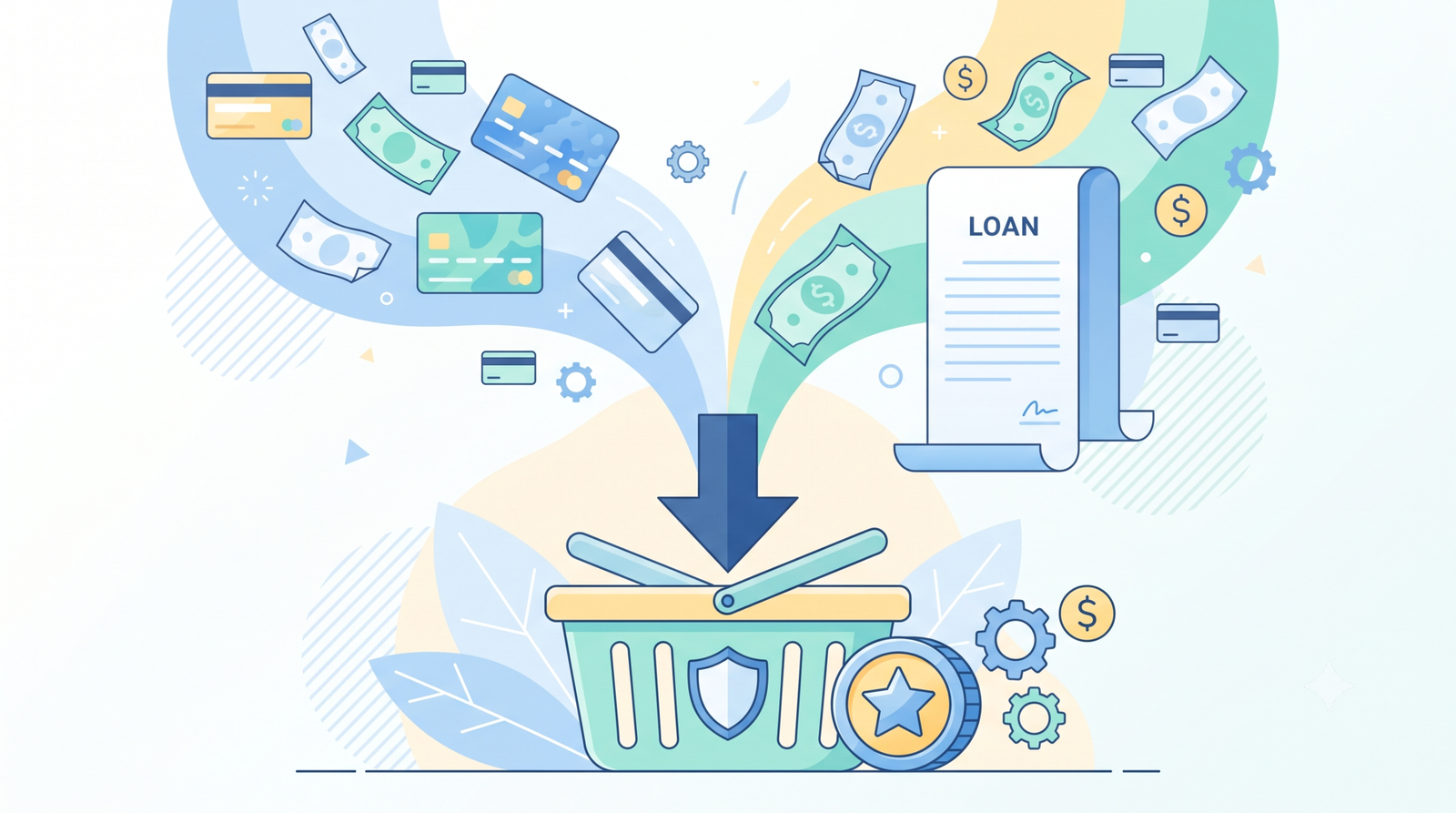
Here’s an appealing thought: take all your scattered, high-interest debts — the credit cards at 24%, the store card at 28%, the medical bill — and roll them into one single loan with one payment and one lower interest rate. Sounds like the obvious solution, right? It’s called debt consolidation, and it’s one of the most heavily marketed debt-relief tools there is.
But there’s a catch that the ads never mention: debt consolidation only works if you change the behavior that created the debt. The loan itself doesn’t erase what you owe. It restructures it. If you consolidate your credit cards and then keep using them, you’re not out of debt — you’re in more debt, just with a cleaner-looking surface.
This guide explains exactly how debt consolidation works, breaks down the real costs and benefits, shows you when it’s genuinely worth it (and when it’s a trap), and gives you a clear checklist to decide if it’s right for you.
What Is Debt Consolidation?
Debt consolidation is taking out one new loan to pay off multiple existing debts. Instead of juggling several payments to different creditors, you have a single loan, a single payment, and — ideally — a single, lower interest rate.
The Core Idea
The goal is to replace several high-interest debts with one that has:
- A lower interest rate (to save money),
- One predictable payment (to simplify your finances),
- A clear end date (to see the finish line).
What It Is NOT
Debt consolidation is not the same as:
- Debt settlement (negotiating to pay less than you owe — that damages credit).
- Bankruptcy (a legal process that discharges debt).
- Debt management plans (where an agency negotiates on your behalf).
Consolidation is simply restructuring — you still pay back everything you borrowed.
How Does Debt Consolidation Actually Work?
There are a few ways to consolidate, and they work differently.
Option 1: A Debt Consolidation Loan
You take out a personal loan and use it to pay off all your credit cards and other debts. You now owe the loan lender instead, usually at a lower rate with fixed monthly payments. (This is a specific type of personal loan — for the full picture, see our personal loans explained guide.)
Option 2: A Balance Transfer Credit Card
You move your credit card balances onto a single card with a 0% introductory APR (often 12–21 months). During that window, your balance doesn’t accrue interest. The catch: you usually pay a balance transfer fee (3–5%), and if you don’t pay it off before the intro period ends, the remaining balance jumps to a regular (often high) rate.
Option 3: Home Equity Loan or HELOC
If you own a home, you can borrow against your equity at a low rate. This is riskier, though — your home is collateral, and if you can’t pay, you could lose it.
Debt Consolidation: The Real Pros and Cons
The Pros
- Lower interest rate — can save you significant money if your current debts are high-rate.
- One payment — simplifies budgeting and reduces the chance of missing a due date.
- Clear payoff date — a fixed-term loan shows you exactly when you’ll be debt-free.
- Potential credit boost — paying off cards lowers your utilization ratio, which can help your score. (Learn how that works in our credit utilization ratio guide.)
The Cons
- It doesn’t fix overspending. If you consolidate and keep using cards, you’ll re-accumulate debt on top of the loan.
- Fees can eat the savings. Balance transfer fees and loan origination fees reduce the benefit.
- Risk of asset loss (HELOC). Using your home as collateral means default could cost you your house.
- Lengthened payoff. A longer term lowers payments but can mean paying more total interest.
- Requires good credit. The best rates go to people with solid scores; poor credit may not get a better rate than your current debts.
Is Debt Consolidation Worth It? A 4-Point Test
Before you consolidate, run yourself through these four checks. If you fail any of them, consolidation is risky.
Test 1: Will Your New Rate Actually Be Lower?
This is the whole point. If the consolidation rate isn’t meaningfully lower than your current weighted average, there’s no financial benefit. Compare your current total interest to the new loan’s total interest.
Test 2: Can You Stop Using the Cards?
If you consolidate your credit cards, you must freeze them — physically or by cutting them up. If you can’t commit to this, consolidation will backfire. This is the single most important test.
Test 3: Can You Afford the New Payment?
The new payment should fit comfortably in your budget. If it’s a stretch, one bad month could lead to a missed payment — and consolidate loan payments are usually fixed and non-negotiable.
Test 4: Are the Fees Worth It?
Add up balance transfer fees and origination fees. If the fees are so high that they erase most of the interest savings, consolidation isn’t worth it.
If you pass all four, consolidation can genuinely help. If not, a different approach — like the debt snowball or avalanche method — is probably better.
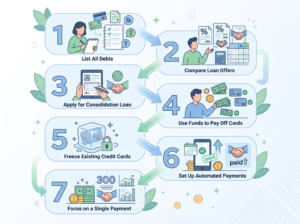
Step-by-Step: How to Consolidate the Right Way
If consolidation passes your test, here’s how to do it safely.
Step 1: List Every Debt
Write down each debt, its balance, rate, and minimum payment. You need the full picture before you start.
Step 2: Calculate Your Weighted Average Interest Rate
This tells you what you’re currently paying overall. It’s your baseline to compare any consolidation offer against.
Step 3: Shop for the Best Offer
Compare personal loan lenders and balance transfer cards. Look at APR, fees, and term length — not just the headline rate.
Step 4: Check Your Credit First
The rate you qualify for depends on your score. Know where you stand. (See our credit score explained guide to understand what affects your rate.)
Step 5: Apply and Pay Off Your Debts Immediately
Once approved, use the funds to pay off your debts right away. Don’t let the money sit in your account.
Step 6: Freeze the Old Cards — Permanently
This is non-negotiable. Cut up the cards, remove them from online wallets, or lock them. The loan only works if the old balances stay paid off.
Step 7: Automate Your New Payment
Set up autopay so you never miss a payment. Missed payments on a consolidation loan hurt your credit and can trigger penalty rates.
Common Mistakes That Make Consolidation Backfire
Avoid these — they’re how “smart” consolidation turns into a worse situation:
- Keeping and using the old cards. This is the #1 way consolidation fails. The new loan + new card balances = worse debt.
- Ignoring the fees. A 5% balance transfer fee can offset a year of interest savings.
- Extending the term too long. A 7-year loan with a low payment looks great but costs far more in total interest.
- Consolidating unsecured debt into a secured loan (HELOC). You’re trading no-collateral debt for your home as collateral — a serious risk.
- Not comparing to your current rate. If the new rate isn’t lower, you’ve gained nothing.
- Using consolidation to “afford” more spending. The freed-up minimum payments should go to the loan, not to new purchases.
Real-World Example: When Consolidation Helped — and When It Backfired
Let’s compare two people consolidating the same $10,000 in credit card debt.
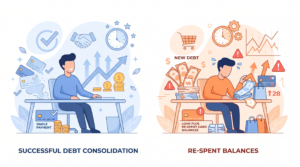
Rosa — consolidation that worked: Rosa had $10,000 across three cards at an average 23% APR. She took a 3-year consolidation loan at 11%, paid off all three cards immediately, and cut them up. She set autopay and made the fixed payment for 3 years. Result: she paid roughly $1,700 in total interest and was debt-free in 3 years — versus the 15+ years and $8,000+ in interest it would’ve taken on the cards.
Marcus — consolidation that backfired: Marcus also took a consolidation loan to pay off $10,000 in cards. But he left the cards in his wallet “for emergencies” — and then used them for daily spending. Two years later, he still had most of the loan and $6,000 back on the cards. His consolidation “helped” him go deeper into debt.
The tool worked for Rosa because she changed her behavior. Marcus kept the habit, so the loan just layered onto the problem. For the underlying payoff strategy, see our debt snowball vs avalanche guide.
Frequently Asked Questions
Is debt consolidation worth it?
Yes, if your new rate is lower than your current debts, you can stop using the old cards, and the fees don’t erase the savings. It’s not worth it if you’ll re-spend or if the rate isn’t actually better.
Does debt consolidation hurt your credit?
It can cause a small, temporary dip (hard inquiry + new debt), but it often helps long-term by lowering your utilization ratio and building on-time payment history. It’s not a quick fix and shouldn’t be done recklessly.
What’s the difference between debt consolidation and a personal loan?
A debt consolidation loan is a specific type of personal loan — used to pay off multiple debts. A personal loan can be used for anything. Consolidation is the purpose; the personal loan is the tool.
Can I consolidate debt with bad credit?
Sometimes, but the rate may not be better than what you already have. If you can’t get a meaningfully lower rate, consolidation may not help — the debt snowball or avalanche might be a better fit.
What’s better: a consolidation loan or a balance transfer card?
It depends on the amounts and terms. A balance transfer card offers 0% for a limited window (great if you can pay it off fast) but adds a fee and a high rate afterward. A consolidation loan has a fixed rate and term. Compare both on your specific numbers.
Can I consolidate while also using the snowball method?
You can, but be careful. If you consolidate, you no longer have separate debts to “snowball” — you have one loan. You can apply snowball-style urgency to paying that single loan off early. Many people consolidate then accelerate payments on the one loan.
Key Takeaways
- Debt consolidation is restructuring, not erasing — you still owe everything.
- It helps when the new rate is lower and you stop using the old cards.
- Balance transfer cards and consolidation loans are the main tools; HELOCs are riskier (home is collateral).
- Fees can erase the benefit — always run the numbers.
- The behavior change is the real fix, not the loan itself.
- Consolidation works for people like Rosa who change habits, and fails for those like Marcus who don’t.
Debt consolidation is a powerful tool, but it’s not a magic wand — it’s a restructuring that only pays off when you change the behavior that created the debt. If you can commit to freezing your cards, get a genuinely lower rate, and afford the payment, consolidation can save you thousands and simplify your life. If you’re not sure you can, there are simpler paths — snowball, avalanche, or a steady payoff plan — that work without the risk.
Ready to build your debt plan? Start with the complete step-by-step guide to getting out of debt. If you’re deciding between a consolidation loan and other options, read our personal loans explained guide and compare payoff methods in our debt snowball vs avalanche guide. And understand the interest you’re consolidating away with our guide to how credit card interest works. This article is for informational purposes only and is not financial advice.



[…] Vs. a debt consolidation loan: A consolidation loan is a specific type of personal loan used to pay off multiple debts — we cover it in depth in our debt consolidation guide. […]
Siedze tu mniej wiecej trzech miesiecy i nie ukrywam zapisalem sie po polecenu kumpla, bo znajomy z innego forum wspominal o tym co drugi dzien. Cala rejestracja trwala moze trzy minuty, KYC zeszlo mi jeden dzien, bez tragedii. Najmniejsza wplata to jakies 40 zlotych, wiec bez szalu.
Automaty to moja glowna dzialka — maja w sumie grubo ponad dwa tysiace tytulow, chociaz realnie odpalam moze dziesiec. Pragmatik wrzuca swoje klasyki — Gates of Olympus i Sweet Bonanza, poza tym masa Play’n GO z Book of Dead na czele, kawalek biblioteki NetEnt oraz Big Time Gaming. Ta strona trzyma przyzwoity dzial live: Evolution z zywymi krupierami, ruletka, blackjack i te ich show’y typu Crazy Time, w ktore wpadam glownie wieczorami.
Bonus powitalny to 100% do 2000 zl plus 200 free spinow, obrot x35 i to jest ta czesc — regulamin czyta sie srednio, wiec czytajcie zanim klikniecie. Byl tez jakis kod bez depozytu, choc chyba juz wygasl — to co obecnie chodzi sprawdzicie na ranking kasyn online pl, bo tam odswiezaja najczesciej.
Wyplaty robilem trzy razy. Skrill idzie tego samego dnia, Mastercard ciagnela sie dwa dni robocze, a przy krypto doslownie kilkadziesiat minut. Ostatnia wyplate odebralem w zeszlym tygodniu i bylo czysto. Rozliczenia w zlotowkach, bez dodatkowych prowizji za wymiane.
Mobilnie chodzi na przegladarce, aplikacji nie ma co mnie lekko irytuje. Obsluga gada po polsku, na czacie czekalem ze cztery minuty, choc mailem odpisali dopiero po dniu. Licencja Curacao — dla mnie ok, ale rozumiem sceptykow. Sprawdzalem kilka podobnych serwisow, to jest gdzies w gornej polowie — solidnie, choc bez fajerwerkow.