

Student Loan Repayment: Options Explained for 2026
Student loan repayment can feel more confusing than the debt itself. Between standard plans, income-driven options, refinancing, and forgiveness programs that seem to change every year, it’s easy to end up on whatever plan you were auto-enrolled in — without ever knowing if it’s actually the best one for your situation.
This guide breaks down every major student loan repayment option available in 2026 — standard, graduated, extended, income-driven, and refinancing — along with who each one actually makes sense for, so you can make a decision based on your real numbers instead of guesswork.
If you’re also carrying other debt beyond student loans, it’s worth reading our complete guide on how to get out of debt for a broader payoff strategy that fits everything together.
Why Your Repayment Plan Choice Matters So Much
Unlike most other debt, student loans come with several structurally different repayment options — not just different interest rates, but entirely different formulas for how your payment is calculated. Choosing the wrong plan doesn’t just mean paying a bit more each month; over the life of a loan, the difference between plans can total tens of thousands of dollars in extra interest, or conversely, years of unnecessarily aggressive payments that could have gone toward other financial goals.
The right plan depends on three main factors: your current income relative to your loan balance, how stable that income is expected to be, and whether you’re prioritizing the lowest total cost or the lowest monthly payment right now.
Standard Repayment Plans
1. Standard Repayment Plan
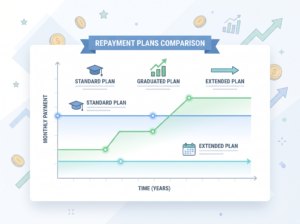
Fixed monthly payments over 10 years. This is the default plan for most federal loans and typically results in the lowest total interest paid, because the repayment period is shortest.
- Best for: Borrowers with stable, sufficient income who want to pay the least interest overall and be debt-free in a decade.
- Trade-off: Monthly payments are higher than other plans, which can strain a tight budget early in a career.
2. Graduated Repayment Plan
Payments start lower and increase every two years, still over a 10-year term. The idea is that your income will rise as your career progresses, so payments rise alongside it.
- Best for: Borrowers early in a career with strong, predictable income growth (e.g., professions with clear salary progression).
- Trade-off: Total interest paid is higher than the standard plan, and payments can become a strain if income doesn’t grow as expected.
3. Extended Repayment Plan
Stretches repayment over up to 25 years, available to borrowers with a higher loan balance (typically above $30,000). Payments can be fixed or graduated.
- Best for: Borrowers who need significantly lower monthly payments and are prioritizing cash flow over minimizing total interest.
- Trade-off: Because the repayment period is so much longer, total interest paid over the life of the loan is substantially higher than standard repayment.
Income-Driven Repayment (IDR) Plans
Income-driven repayment plans calculate your monthly payment as a percentage of your discretionary income rather than a fixed amount based on your balance. These plans typically extend repayment to 20–25 years, with any remaining balance potentially forgiven at the end of the term (though forgiven amounts may be taxable, depending on current law).
Key features shared across most income-driven plans:
- Monthly payments are recalculated annually based on updated income and family size documentation.
- Payments can be very low — even $0 — during periods of low or no income.
- Remaining balances after the repayment term may qualify for forgiveness, subject to program rules in effect at that time.
- Because payments are sometimes lower than accruing interest, loan balances can grow before eventually decreasing — a trade-off borrowers should understand going in.
- Best for: Borrowers with high loan balances relative to income, unpredictable income, or those pursuing Public Service Loan Forgiveness (PSLF), which requires an income-driven plan to qualify.
- Trade-off: Extended repayment periods generally mean more total interest paid if forgiveness isn’t ultimately achieved, and payments can increase significantly if income rises.
Because federal income-driven repayment programs and their specific terms are actively updated by policy changes, always verify current plan details and eligibility directly through your loan servicer or the official federal student aid website before enrolling.
Refinancing Through a Private Lender
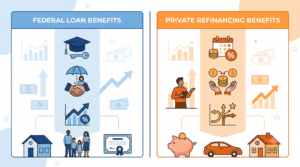
Refinancing replaces one or more existing loans with a new private loan, ideally at a lower interest rate. This can meaningfully reduce total interest paid — but it comes with an important, often overlooked trade-off.
What refinancing can offer:
- A potentially lower interest rate if your credit and income have improved since taking out the original loans
- The ability to combine multiple loans into a single monthly payment
- Flexible new term lengths
What refinancing gives up (critical for federal loan holders):
- Access to income-driven repayment plans
- Eligibility for federal forgiveness programs, including Public Service Loan Forgiveness
- Federal deferment and forbearance protections during financial hardship
- Federal loan pauses or relief measures that may be enacted during future economic disruptions
- Best for: Borrowers with private loans already, or federal loan borrowers with stable high income, strong credit, and no intention of pursuing forgiveness or needing federal hardship protections.
- Trade-off: Once federal loans are refinanced into a private loan, this conversion is permanent — federal benefits cannot be restored afterward.
How to Choose the Right Plan: A Decision Framework
Rather than comparing every plan in the abstract, ask yourself these questions in order:
- Is my income currently low relative to my loan balance, or unpredictable? If yes, an income-driven plan likely makes the most sense right now, even if it costs more in total interest long-term.
- Am I working toward Public Service Loan Forgiveness or another forgiveness program? If yes, refinancing is very likely the wrong move, since it forfeits federal forgiveness eligibility entirely.
- Can I comfortably afford the standard 10-year payment without straining my budget? If yes, the standard plan usually results in the lowest total cost and fastest payoff.
- Do I have strong credit and stable income, with no plans to pursue federal forgiveness or need hardship protections? If yes, refinancing to a lower rate may reduce total interest paid meaningfully.
- Is my top priority lowering my monthly payment even if it costs more in total interest? If yes, extended or graduated repayment may fit, understanding the long-term cost trade-off.
Real-World Example: Comparing Plans on a $35,000 Balance
To illustrate how dramatically these choices can differ, here’s a simplified comparison for a borrower with a $35,000 federal loan balance at a 6% interest rate:
| Plan | Approx. Monthly Payment | Repayment Term | Approx. Total Interest Paid |
|---|---|---|---|
| Standard (10-year) | $389 | 10 years | ~$11,660 |
| Extended (25-year) | $225 | 25 years | ~$32,500 |
| Income-Driven (est., moderate income) | $180–250 | Up to 20–25 years | Varies significantly; may include forgiveness |
These figures are simplified estimates for illustration only — actual amounts depend on your specific loan terms, income, family size, and the exact program rules in effect. Always confirm real numbers directly with your loan servicer.
This comparison shows the core trade-off clearly: the standard plan minimizes total cost but requires the highest monthly payment, while extended and income-driven plans reduce monthly strain at the cost of significantly more interest over time — unless forgiveness ultimately applies.
Common Mistakes to Avoid
- Staying on the default auto-enrolled plan without reviewing alternatives. Many borrowers never actively choose a plan — they simply keep whatever they were assigned after their grace period ended.
- Refinancing federal loans without understanding the permanent loss of protections. This is the single most common regret among borrowers who refinance too quickly, especially those who later experience income disruption.
- Not recertifying income annually for income-driven plans. Missing recertification can cause your payment to jump dramatically or temporarily revert to the standard formula.
- Assuming forgiveness is guaranteed. Forgiveness programs are subject to policy changes; borrowers pursuing forgiveness should stay informed of current requirements rather than assuming today’s rules will remain unchanged for the full 20–25 year term.
- Only comparing monthly payment amounts, not total interest paid. A lower monthly payment can look attractive short-term while costing significantly more over the life of the loan.
Frequently Asked Questions
What is the best student loan repayment plan?
There’s no single best plan — it depends on your income stability, loan balance, and whether you’re pursuing forgiveness. Borrowers with stable, sufficient income generally save the most on the standard 10-year plan, while those with lower or unpredictable income often benefit more from an income-driven plan.
Can I switch repayment plans after I’ve already chosen one?
Yes, in most cases federal loan borrowers can switch plans, though there may be limits on how frequently you can change and some plans have specific eligibility requirements. Contact your loan servicer to review your current options.
Does refinancing student loans always save money?
Not always. While a lower interest rate can reduce total interest paid, refinancing federal loans permanently forfeits access to income-driven plans, federal forgiveness programs, and federal hardship protections — trade-offs that matter significantly for many borrowers.
What happens if I can’t afford my student loan payment?
Income-driven repayment plans, deferment, and forbearance are options worth exploring before missing payments, which can damage your credit. Contact your loan servicer as soon as you anticipate a problem rather than after payments are already missed.
Should I pay off student loans or save for other goals first?
This depends on your interest rate relative to other financial priorities. For a broader framework on balancing debt payoff against other goals, see our guide on debt snowball vs debt avalanche methods.
Key Takeaways
- Standard repayment minimizes total interest but requires the highest monthly payment; extended and graduated plans lower payments at a higher total cost.
- Income-driven repayment plans calculate payments based on income rather than balance, and may lead to eventual forgiveness — but extend the repayment timeline significantly.
- Refinancing federal loans can lower your interest rate but permanently forfeits access to federal forgiveness programs and hardship protections.
- Choose your plan based on income stability, whether you’re pursuing forgiveness, and whether your priority is lowest total cost or lowest monthly payment.
- For a broader debt payoff strategy that includes student loans alongside other debt, see our guides on how to get out of debt and debt snowball vs debt avalanche.
This article is for informational and educational purposes only and is not personalized financial advice. Student loan program rules change frequently — always verify current details with your loan servicer or official federal student aid resources before making a decision. Consider speaking with a licensed financial professional for guidance specific to your situation.